Category Archives: Energy

Natural gas, the green(er) choice?

This post was first published on The Oil Drum. Read there for 100+ comments.

Natural gas is regarded as a relatively environmentally friendly way of generating electricity. Gas burns cleanly without many of the problems associated with coal. Coal is a chemically complex substance. When it is is burnt, it releases oxides of sulphur (SOx) and nitrogen (NOx), traces of mercury, selenium and arsenic, as well as particulates, and a non-combustible slag remains after burning. Coal mining is also a dirty and dangerous job.

Coal emits considerably more CO2 than natural gas per unit energy. However, natural gas (CH4) itself is a potent greenhouse gas, and its release to the atmosphere without being burnt can quickly compensate for the CO2 advantage against coal.

Generating electricity from fossil fuels typically involves their combustion in large power stations. Due to the molecular differences of coal, oil and gas, different amounts of carbon dioxide are produced for each unit of thermal energy. For example, the EIA tells us coal (anthracite) releases 227 pounds of CO2 per million BTU (or 351 g/kWh thermal), fuel oil or diesel 161 lb/MBTU (249 g/kWh) and natural gas releases 115 lb/MBTU (178 g/kWh). This, coupled with the variability in power station thermal efficiency leads to significant variations in the amount of CO2/kWh of electricity emitted.

The figures below are for the UK electricity grid.
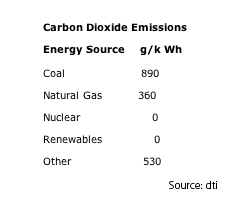

This table was lifted from: http://electricityinfo.org/co2emissions.php

These CO2 emissions are directly related to the fossil fuel combustion and power station efficiency. Lifecycle emissions are not included, leaving nuclear and renewables at zero, because emissions related to construction, decommissioning, uranium processing etc. are ignored. Natural gas is considered the ‘greener’ fuel as electricity from gas emits 2.5 times less CO2 than coal, as well dramatically lower CO, NOx and virtually no SOx or particulates.

There is an issue of system boundaries here. The figures above only consider the power station and not any upstream supply system. While CH4 may leak from the gas pipelines, there are also CH4 releases from coal mines. For this post, let’s consider emissions after the mine mouth or well head, and ignore emissions associated with transporting coal.

For oil and coal, the only significant route into the atmosphere is via combustion. However, besides being burnt, natural gas can be released without combustion as methane, CH4. This becomes interesting when one considers both the impact of atmospheric emissions of CO2 and CH4. Both are greenhouse gases in that they that absorb and emit radiation within the thermal infrared range of the electromagnetic spectrum, however their respective radiative forcings are very different. The radiative forcing measures how much a greenhouse gas (or other factors) alters the balance of incoming and outgoing energy in the Earth-atmosphere system.

The Carbon Dioxide Information Analysis Center (CDIAC) part of the US Dept. of Energy uses Global Warming Potential (GWP), as it provides a simple measure of the radiative effects of emissions of various greenhouse gases, integrated over a specified time horizon and relative to an equal mass of CO2 emissions. Over a common 100 year time horizon CDIAC state the global warming potential of CH4 as 25 times greater than CO2 [link]. The calculation is not trivial, and estimations do vary a little, but for this analysis the factor 25 is sufficient.

We saw above that natural gas emits 2.5 times less CO2 than coal when used to generate electricity. However, when CH4 is released to the atmosphere without first being combusted, the global warming potential is 25 times higher than CO2. It is a more potent greenhouse gas. If only a little natural gas is released without being burnt, it will dominate the radiative forcing and more than compensate for the 2.5-fold advantage gas has over coal.

The chart illustrates this effect:
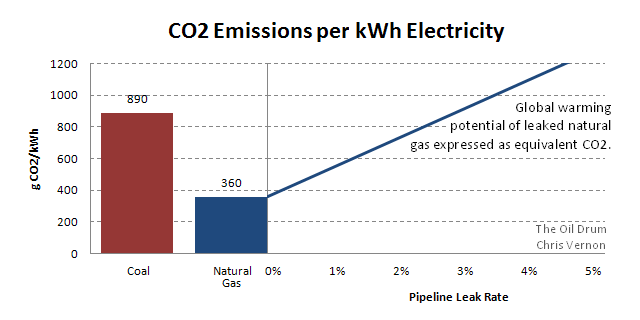

On the left, CO2 emissions per kWh for coal and natural gas. On the right, the global warming potential of leaked CH4 expressed as CO2

If the natural gas leak rate is 3%, the global warming potential of a kilowatt-hour of electricity from gas is equivalent to coal.

Leak Rates

So what are pipeline leak rates? A 1997 US Environmental Protection Agency report states US methane leak rates were 1.4 +/- 0.5 % in 1992. The largest source of leakage at that time was compressor components used in the processing, transmission, and storage, followed by the distribution network itself, with the small length of old cast iron pipes leaking disproportionately highly. The natural gas production process also contributes through millions of slowly leaking pneumatic control devices. A larger study carried out from 2005 by Brazil’s largest gas distributer Comgas suggests cast iron pipe leak rates double the EPA study.

A 1990 study for Greenpeace considered the UK distribution network then operated by British Gas. Greenpeace estimated low, medium and high scenario leakage rates of 1.9%, 5.3% and 10.8% respectively. This was in contrast to the 1% claimed by British Gas at the time. The authors were confident leakage rates were above 1.9%. These figures are likely obsolete today as there still existed a large amount of pre-1970 cast iron pipe work, much of it since replaced. In 1990 only 39% of the UK mains and 74% of the service pipes were plastic.

The 1.4% figure is also old, and only refers to the US, but it is a significant magnitude, it represents a 70% increase in global warming potential compared to the CO2 alone and halves the CO2 advantage gas has over coal based on the 360 and 890 g/kWh figures above.

Whilst these figures do not tip gas beyond coal, they halve its advantage. They are also only national. For the US this is quite understandable, but for the UK and Europe, the gas system is changing. Could leak rates become important as natural gas supply routes become longer? As Europe increases its reliance on Russia, as previously stranded gas is brought to market through longer pipelines than before, as a larger number of smaller deposits are exploited and as existing infrastructure ages, it seems likely that leak rates will increase. We often hear about struggles in the former Soviet states related to gas – is the leak rate there one percent or five? Is it economically feasible for the pipeline operator to make investments to stem the last percentage point of a system’s leaks?

Is it possible that a ‘green’ gas power station in the UK is making a greater contribution to global warming than one burning coal?

Does anyone have recent data on leakage rates, especially for Russia and Eastern Europe?

The UK “Oil Age” Begins

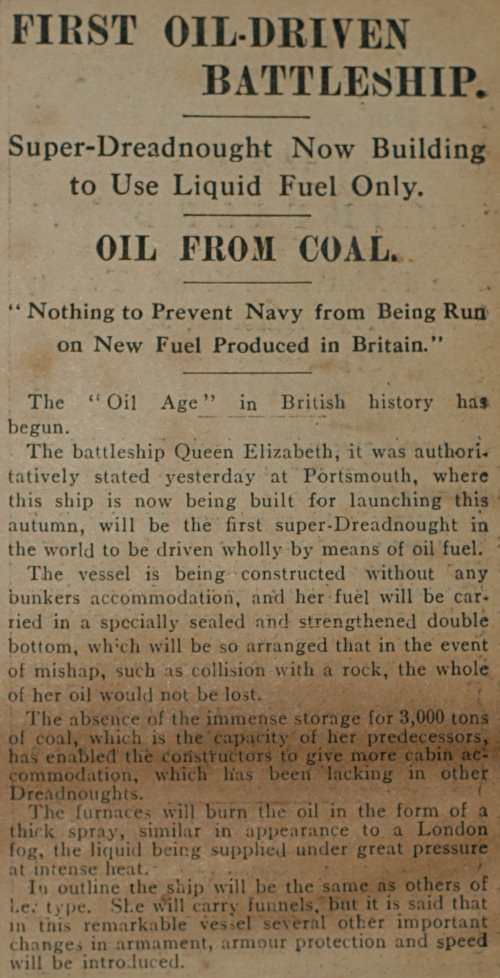
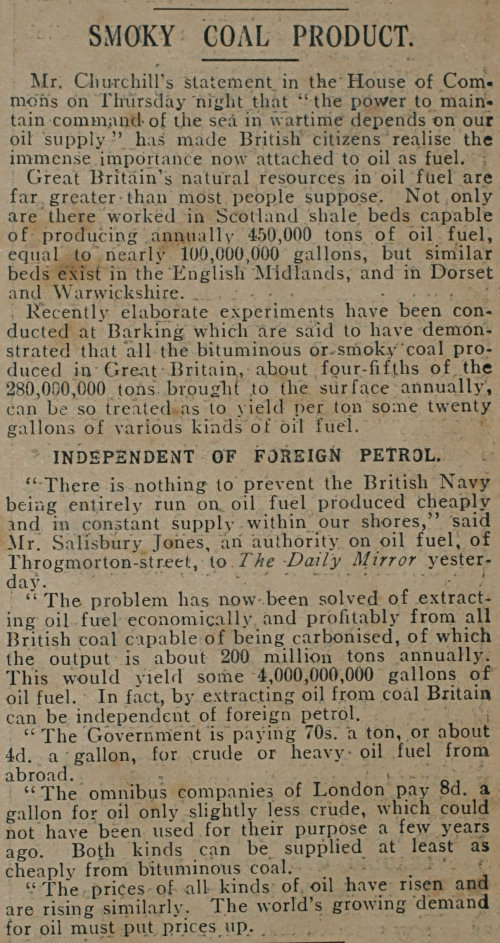
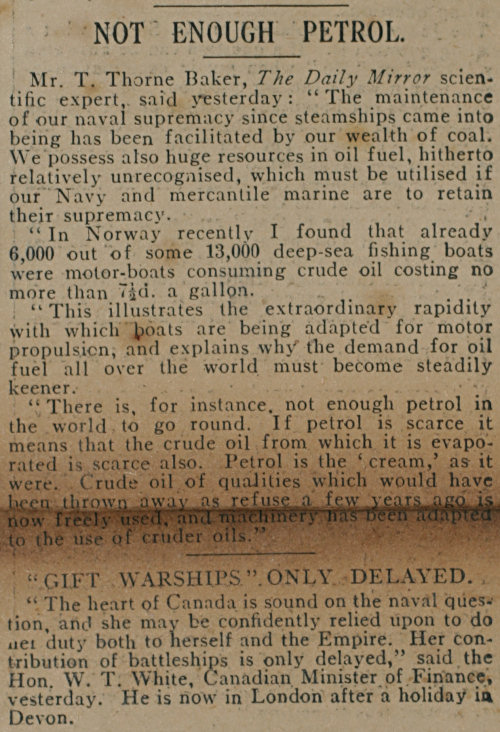
A couple of years ago I came across a single page from the Daily Mirror from 19th July 1913. It had been in the back of an old picture frame my mother was working on. This would have been interesting in itself but this 97 year old sheet of paper had a very interesting story about the construction of Great Britain’s first oil-driven battleship heralding the beginning of the “Oil Age”.

Winston Churchill underlines the military importance of imported oil, leading the discussion to the country’s potential self sufficiency in oil. Clearly this is decades before off-shore oil discoveries in the North Sea so shale beds are considered along with a recent breakthrough demonstrating how some 20 gallons of oil can be economically produced from a ton of coal.

Of course some things never change, growing world demand was even reported to be forcing up the price of oil in 1913. As it turned out the UK never embarked on economically significant coal to liquids programmes or exploitation of the shale resources.

Further information on HMS Queen Elizabeth is available here: Wikipedia


It’s an interesting coincidence that just as coal was being discussed as a future source of liquid fuel UK production was peaking. The all time peak production rate of UK coal was 1913:

UK Coal Production

UK Coal Production

UK Coal Production (D. Rutledge)

The image below shows the construction of an oil storage depot at Killingholme. Interestingly this is now the site of a large ConocoPhillips oil refinery, opened in 1969 and sited here as a good place to land North African crude. The simultaneous discovery of North Sea oil made it a highly successful venture now responsible for 10% of UK petrol and 14% of all other oil products.

Lights Out For Incandescents

Light bulbPeak oil may be upon us, but I fear the primary challenge for the UK isn’t oil but rather electricity. With rapid decommission of the aging nuclear fleet and falling extraction rates of indigenous natural gas and coal, our three main sources of electricity (accounting for some 95% of our electricity supply) are all in decline.

For this reason, the country is planning an incredible increase in natural gas and coal imports – with apparently little concern for the effect on the balance of payments or the security of supply. Political debate is also approaching the need for a new nuclear build programme. However I am left thinking that although this shortage is arising from declining supply, the solution lies on the demand side.

This earlier article on Dynamic Demand shows a simple method which adjusts the profile of demand with respect to supply, allowing a far greater degree of intermittency to be tolerated without sacrificing utility. This in turn eases the deployment of renewables, usually criticised for their intermittency compared to traditional energy generation.

Light Bulbs
I have recently moved house and was amazed by the lighting arrangements in the new property. Incandescent bulbs throughout, with multiple spot lights in the kitchen and one other room, and not only that but each bulb had a lampshade hanging below it shadowing the room so that even with 100W bulbs the rooms were dim.

We’ve been using compact fluorescents for about 5 years now, but now I’m thinking enough is enough. Tesco et al need to stop selling 100W incandescent light bulbs for 18 pence each. In fact, the Tesco price isn’t the issue; I believe government should legislate against the manufacture, import and sale of incandescent bulbs. There is just no justification for incandescent bulbs and every reason for us to reduce our electricity consumption. The incandescent light bulb is as old as domestic electricity itself, its invention credited to Thomas Alva Edison in 1879, and remains little changed to this day. I think it’s time to bid farewell to this invention, celebrating the profound impact it has had on civilisation whilst at the same time recognising its inefficiency and therefore unsuitability for an energy scarce future.

At a personal level each 100W bulb used for an average of four hours a day will use 146kWh a year, costing £10.22 (at a typical 7 pence per kWh). Compare this to the 20W equivalent compact florescent which only uses 29.2kWh costing just £2.04 over the year, a saving of £8.18 per bulb. Say the average household has five bulbs with that kind of duty cycle and we’re looking at an annual saving of £40.88 on the electricity bill.

Some common misconceptions about modem compact fluorescents are covered here:

Do they flicker when you turn them on?
Yes, they do, but unlike early energy saver lamps a few years ago, the latest designs generally include electronic rapid start circuitry to make the lamp light in less than 1 second with virtually no flickering.
Don’t they give a rather harsh light?
Some older designs had quite a high “colour temperature” (see glossary) which may be perceived as “colder” but many energy saving lamps now use a “warm white” coating to make the light very similar to a normal incandescent bulb.
Do they take time to “warm up”?
The latest compact fluorescent lamps “warm up” very much faster than older designs, typically reaching 95% of their full light output in under a minute.
They are always too long and stick out above my lampshade!
Again, with the latest designs, this need not happen. Many compact fluorescents are now so small that they are virtually the same size, or even smaller, than ordinary bulbs. If the bulb is visible, you can choose from one of the designs that uses a decorative outer bulb to cover the fluorescent tubes.
Lightbulbs Direct

Compact fluorescents do cost more, typically a minimum of £3-5 compared with incandescents at 40 pence (I can only assume the 18 pence Tesco bulbs are a loss leader, similar to the £1.49 Ikea compact fluorescents, so won’t use those figures), however since compact fluorescents last 5 to 10 times longer than incandescent this unit cost differential is negligible.

At the national level, each of the 22 million homes saving 585kWh a year would save 12.9 Terawatt hours. For reference, a large nuclear power station generates approximately 8.8 Terawatt hours a year. So just the single, simple, modest action of replacing the incandescent light bulbs in domestic homes (which could be phased in over several years as incandescent bulbs need to be replaced) would reduce our electricity demand by one and a half nuclear power stations worth.

If government were to ban incandescents in a similar way as lead pipes and asbestos are already banned, then the average household would save around £40 a year and the nation would save the construction, operation and decommission of one and a half nuclear power stations (or equivalent gas/coal imports). Other benefits might include reduced number of household fires started by hot lamps or faulty wiring (less current being drawn through the lighting circuit), fewer people falling off chairs or electrocuting themselves changing bulbs (since the number of changes would be reduced by 80-90%), and less raw materials and landfill needed for construction and disposal of incandescents.

Any absolute ban like this would also remove incandescents from business and industry providing further energy and financial saving on top of those discussed for domestic users.

Intermittency of Renewable Energy

Wind turbineOne of the common complaints levelled against the deployment of renewable energy like wind and solar on the national grid is that of intermittency. What good is a source of energy if you can’t rely on it to be there when you need it? Intermittency is managed today by ensuring that intermittent sources only provide a tiny fraction of the total supply or by keeping reserve generation capacity ticking over in the background ready to step in on short notice as the wind drops.

This situation isn’t ideal and isn’t necessary. Today you and I sitting at home in front of our grid-connected computers expect the moon on a stick, we expect to be able to use any and all of our electrical appliances for as long as and whenever we want. This grade of service is difficult to maintain and will become impossible as we decommission our ageing nuclear fleet and burn through the last of our indigenous North Sea gas. In the future we will be left reliant on more intermittent sources of energy leaving us with the challenge of maintaining our comfort and utility from this new source of energy.

We must adjust our energy consumption is such a way that we don’t all, up and down the country, make demands on the grid at the same time or when the wind isn’t blowing.

My first (and totally impractical but I mention it here to illustrate the point) idea of how this could be accomplished involves having two circuits in the home, a red circuit and a green circuit. The electricity to each circuit would be metered separately and charged at different rates, for example the ‘red electricity’ might be 10 pence per kWh and ‘green electricity’ might be only 2 pence per kWh. The difference between the two would be reliability. The red circuit would be virtually 100% reliable, into this circuit you would plug the freezer, fridge, some lighting, central heating pumps etc. The important appliances. The green circuit would be less reliable, it might regularly cut out at times of peak load, advert breaks in Coronation Street, unusually cold weather or when the wind wasn’t blowing. The important point here is that really important appliances wouldn’t be lost when there wasn’t enough power. A power cut on the green circuit wouldn’t really matter that much, we would be more tolerant of the intermittent supply than we are now where a power cut means lights out, game over.

Of course no one actually wants two circuits in the house and just having two circuits doesn’t provide a very smooth response. What we really need is for demand to automatically shape itself to match instantaneous supply and we want this to happen without us even noticing. Not possible? Well maybe it is. This is where Dynamic Demand and appliances that can continuously monitor the condition of the grid and adjust their usage accordingly come in.

To quote straight from their site:

Dynamic Demand aims to promote the introduction of “dynamic demand control” technologies on the UK power grid by advocating institutional change and stimulating research and discussion.
Demand control technologies could provide significant stability and peak demand management for the electricity network. This could lead to significant carbon dioxide savings and may help facilitate the connection of greater amounts of intermittent renewable energy generation, such as solar and wind power.

This is a snapshot of a meter monitoring the power balance of the UK electricity grid (click the meter to see the live status of the grid).


The meter shows the grid’s “frequency”, which is related to the speed of rotation of generators all over the country. When there is too little power available, the whole grid “slows down” and the needle moves to the left.

This can be measured from any power socket by any electrical appliance; the appliance would know the instantaneous imbalance on the grid. These dynamic demand appliances would react to this information, switching on and off or just adjusting their consumption with respect to how much power was available.

Millions of such devices acting together would act like a huge, fast-reacting back-up system mitigating the problem of intermittency.

What is happening?
There is Early Day Motion 388 tabled by Colin Challen MP and the “Management of Energy in Buildings” Bill which introduces dynamic demand is being introduced by Alan Whitehead MP.

There is information on how you can ask your MP to support Dynamic Demand here.

Dynamic Demand looks to me to as a fantastic way to address the inevitable problems facing our electricity supply and the enabling technology for greater use of renewable intermittent energy sources whilst avoiding the threat of complete blackouts at peak load. Maybe at peak load your Dynamic Demand electrical shower, oven or hair dryer wouldn’t work but losing the utility of a few devices like that for a short while is far better than the alternative of widespread blackouts.

Peak Oil Day 2005: Peak Speak

BedzedPowerSwitch held a peak oil conference on the 16th of July at the BedZed zero emission urban development in Hackbridge, London. PowerSwitch was established in Autumn 2004 with the intention of raising awareness and discussion in the UK of the consequences of global oil depletion following the imminent peak in global oil production, and how to deal with it -especially within a context of global warming and sustainability. The conference, titled Peak Speak, provided a platform to discuss the causes, consequences, and mitigation of the peak and decline in global oil production, and action that can be taken. Attended by approximately 50 people with seven speakers the event was well received with vibrant discussion after every speaker. The event opened with James Howard of Powerswitch introducing Powerswitch and the conference, setting the tone for day.

The new documentary Peak Oil: Imposed by Nature had it’s first public screening, inevitably compared to the familiar End of Suburbia the new film is shorter at just 30 minutes but covers the material well featuring Colin Campbell, Matthew Simmons and Chris Skrebowski amongst others. The DVD can be purchased from PowerSwitch here: http://www.powerswitch.org.uk/order.htm

Areas covered by the main speakers were:

Norman Church – Systems and Interdependencies
Norman highlighted how all the major systems of society are interdependent of one another highlighting the three core systems of power, banking/ finance, and telecommunications. The 2000 fuel protests and their effects were described in detail offering a glimpse of how fragile the system is today. Norman ended with a fantastic analogy comparing a big ship and lifeboats with our current civilisation and off-grid self sufficiency. Even a big ship in trouble is far better than a lifeboat on the high seas, taking to the lifeboats should be the last resort, though when trouble looms it would be wise to be prepared. Man the life boats, learn how to row, prepare to leave the big ship but don’t leave prematurely only to see the big ship sail over the horizon without you.

Tully Wakeman – Oil & World Agriculture
Tully Wakeman of East Anglia Food Link spoke on the impact of peak oil on the world’s food system. Our food system is currently highly energy-intensive, using around 10 calories of fossil fuel to produce, process, distribute and prepare each 1 calorie of food. Clearly in a post-fossil world food needs to provide more energy than it consumes. Energy is used approximately 1/4 in production, 1/2 in distribution and processing, and 1/4 in the home. The good news is that it will be fairly easy radically to reduce the energy consumed by moving to local, low-input, seasonal, unprocessed food. The more difficult questions concern the world’s ability to feed its current population without oil, and at a time when a number of other ecological constraints are beginning to make themselves known (climate change, depleted freshwater supplies, depleted soils etc). On balance Tully was optimistic that much of the world could adapt through a combination of market pressures and government intervention (eg rationing), although there would inevitably be ructions and there would also be particular parts of the world which would really suffer. But the changes will be major, and in particular imply a shift of the population towards rural areas (to reduce food transport but also to facilitate nutrient recycling) and also into farming (achieving high productivity without chemicals is labour-intensive).

David Fleming – Nuclear Power / DTQs
David covered two topics, nuclear power was considered from a waste management and uranium supply point of view. Clear arguments were presented that our current application of nuclear power is unsustainable since the waste is currently filed in the ‘too difficult pile’, not dealt with at all and that there isn’t enough uranium in sufficient quantities to be mined anyway. There are many reasons why a world facing peak oil shouldn’t turn to nuclear but the key point was lack of uranium trumps them all.

David also presented Domestic Tradable Quotas (DTQs), a scheme for rationing, and rapidly reducing, the use of fossil fuels, by sharing out access to fuel among every individual and organisation in the economy. They are intended as an effective, efficient and equitable means of reducing carbon emissions in the context of climate change and fuel rationing in the likely event of deepening scarcities in the supply of oil and gas (the oil peak).

The scheme is designed to be equally suited to both these purposes, providing ways of regulating demand for fuel both for climate reasons, and fuel supply reasons, as required. It includes all participants – consumers, industry, Government departments – within a single market, to which they all have access and on which they can buy and sell carbon units within a single Carbon Budget. The Budget is a guarantee that targets requiring the political economy as a whole to reduce its dependence on fossil fuels will actually be achieved. Further information is available on David’s DTQ website: www.dtqs.org.

Chris Vernon – Britain’s Energy Future
PDF of slides
I presented the UK energy mix, concentrating on electricity supply. The UK’s ageing nuclear fleet currently providing 23% of electricity is soon to be decommissioned and the 38% provided by North Sea gas is in jeopardy due to rapid indigenous depletion. The balance currently made up from coal faces CO2, SO2 and NOx emission limits requiring very large capital expense to clean the current infrastructure or a switch to expensive, scarce, foreign very low sulphur coal. One point of note is that the existing nuclear plants are built on the coast, many only just above sea level. Decommission is projected to take 200 years before 100% clean, pessimistic sea level rise could see many of these old reactors under water before fully decommissioned!

Rosamund McDougall – Optimum Population
Rosamund McDougall of Optimum Population Trust (OPT) spoke of the need to reduce human population size suggesting it will be unable to sustain current population levels to the end of the century let alone support the projected increase in light of fossil fuel, fresh water, top soil and other resources become scarce. It seems obvious that populations can not continue to increase indefinitely yet still the government hasn’t defined it’s position on population rise. OPT aims to research and raise awareness of over population whilst opposing the views that perpetual population growth is a good thing and that an ageing population does not call for mass immigration or increased birth rate.

Julian Jackson – Local Currency
Complete transcript
Julian suggested that peak oil could be accompanied by a collapse or at least personal unavailability of government backed currency systems. However in this event the requirement to exchange products and services with your local neighbourhood will still exist. A local currency allows local trading in a far more flexible way than bartering. Julian recommended Short Circuit by Richard Douthwaite (free).

Clive Smith – Personal Preparations
Clive presented some very sound advice on personal preparations. One of the key points being that many items that are readily available now may be scarce or very expensive in the future. It makes sense to stock up on such items now and it’s important to try and convince friends, family and neighbours to do like wise unless you are able to stock up enough to share for when they come knocking on your door.

Material from all presentations will be available at www.powerswitch.org.uk shortly.

Bedzed Crowd

Peak Oil: Two Approaches, One Answer

There are two distinct ways to think about and present the phenomenon of peak oil. It’s easy to describe what peak oil actually is, it’s the global peak in extraction rate of petroleum. It could be specified as the peak rate in million barrels per day or the date on which this peak extraction rate will occur. The difficulty of course is determining the date and associated extraction rate of peak oil. This is where I see the two camps.

Firstly we have the school of Hubbert, including Colin Campbell of ASPO – the geologists. Their methodology dates back to Hubbert’s 1956 paper titled Nuclear Energy and the Fossil Fuels in which he famously and correctly I might add, calculated peak oil for the lower 48 states of the United States as 1970. Even in 1970 he was still ridiculed with people pointing out with glee that the US oil industry had never been more productive. The irony is that whilst they were correct, what the critics didn’t realise is that the US would never again be as productive as in 1970.

Today US extraction rates are less than half what they were in 1970. The way Hubbert (and others after him) calculated peak oil is based on two key points, an estimate of ultimate recoverable reserves (URR) and that the profile of the extraction rate curve is the derivative of the logistic curve and follows the well known bell-shaped curve, the area under the curve representing the URR. These two points and historic extraction data allows the complete curve to be calculated complete with date and extraction rate at peak.

This theory is sound and has been proven in many provinces which are now most definitely past their peak and in decline, including America, Norway, Venezuela, UK, Indonesia etc. All that remains is to calculate the peak for the world. The only point of contention regarding the Hubbert analysis is what the global URR will turn out to be, make an assessment of global URR and the date of global peak oil is just a quick calculation away. This is the methodology behind Colin Campbell’s work from which he is today predicting global peak oil in 2007.

Secondly we have Chris Skrebowski editor of Petroleum Review and his work on oil mega projects – the analyst. Skrebowski also predicts peak oil but doesn’t look at global URR, doesn’t worry about the vagaries of OPEC reserve reporting or make predictions about likely future discoveries, all points on which Campbell’s approach can be challenged. Skrebowski looks at the production profiles of fields today, those in decline, those in ascension and those holding steady. This data is clear. We know the depletion rate of the already peaked provinces mentioned above so we know that if we don’t build any new supply capacity global extraction rates will decline, they would have been declining for decades. Fortunately, in the past natural declining production in existing fields has been more than compensated for by new projects, net production has increased. Where Skrebowski sees a problem is looking forward over the next five years.

Looking out to the end of the decade we know how much of today’s production we are going to lose each year to natural, already occurring depletion. We also know how much new capacity is coming on line, the new oil projects. These new projects are no secret, the oil companies boast about them, letting the world know how much they are investing, when and how much oil the project will extract. Since it takes more than five years between discovery of an oil field or even the decision to develop an already discovered field and the field going into production we can be sure of all new production coming to market until the end of the decade, the die is cast. If it hasn’t started yet it won’t deliver this decade.

Here’s the problem, adding planned new production to depletion rates of existing fields doesn’t add up for long. According to Skrebowski new production isn’t adequate to offset the depletion we already know about and projected increases in demand past 2007/08. This prediction is also on the optimistic side, it assumes everything goes to plan, the uncertainty in this calculation is all on the negative side. Projects can slip but never deliver before schedule, project output can disappoint but never exceed expectation, existing provinces can unexpectedly enter decline but already declining provinces never unexpectedly halt their decline, wars and civil unrest could occur.

2007/08 is a familiar year. These two completely different approaches of Campbell and Skrebowski produce the same prediction for global peak oil. I think they’re on to something.

BBC Reporting Irresponsibly Negligent

BBC NewsWhilst in Dublin at the Feasta Conference I was able to keep up with news over the Internet. The BBC News front page had a three interesting stories on Friday 24th June 2005.

Firstly Oil price hits $60 for second day which reported on the second consecutive day of >$60 oil. The reasons were given as: demand not slackening off despite an almost 40% increase in the price of crude oil since the start of 2005, OPEC already saying it’s doing all it can to meet demand and cool price growth, China importing 8.2% more oil than last year, threats of disruption in Nigeria, and the spectre of a looming strike by oil workers in Norway. Whilst all these points are probably true and the article probably had a world limit, the lack of asking why supply was having difficulty meeting demand or mentioning the rapid decline in some provinces is disappointing.

The second front page story of the day was BA ups fuel surcharge on tickets reporting that from 27 June, BA will increase the fuel surcharge on each long-haul return ticket to £48 ($87) from £32. The short haul surcharge will go up to £16 from £10. The increase was explained by continuing rise in global oil prices… but no mention or questioning as to why global oil prices were rising.

The third story and the one that made me write this article was titled British Gas mulls 15% price rise. It is the news that British Gas are warning of a 15% increase in gas prices this year (on top of the 5.9% in January and 12.4% in September rises last year). I’m sure you’ll agree these are significant rises so one would expect a crack team of BBC investigative journalists would find out what’s behind these incredible rises. It turns out that our gas bills are rising since “wholesale gas prices were now expected to be 51% higher than a year ago.” That’s it. Case closed. I say the BBC are being negligent in not finding out and reporting why wholesale prices are rising 51%. I think it has something to do with UK North Sea gas extraction rates falling 13.5% in a year but what do I know?

One other point I’d like to make is that the BBC carried Adam Porter’s excellent report ‘Peak oil’ enters mainstream debate a couple of weeks ago. None of the three BBC articles on Friday even had a sidebar link to the report, they all deserved one.

I believe the BBC are making positive editorial decisions not to mention peak oil in regular news stories. Why, I do not know. Until we have a media that is at least willing to ask why what we are seeing is actually happening we can not hope for any proactive action to be taken.

Mainstream Peak Oil Film: The Deal

The DealToday I heard about a new film that was released in the States on the 17th June 2005. It sounded like a run of the mill corporate, political, espionage affair but it was about oil and there aren’t very many mainstream films about oil so I thought I’d investigate a little further.

The film is called The Deal with the strap line To The Victor Goes The Oil.

One point of note is that the film was written by a former vice president of Goldman, Sachs & Co. in collaboration with the former head of the Goldman Sachs Oil and Gas department. Again we are hearing from the old timers, okay I don’t know how old they are but it sounds like they are no longer in those high profile roles. Maybe through this film they are able to offer a glimpse into what really goes on behind the scenes of these major organisations.

The official blurb goes like this:

In the near future, as war rages in the Middle East and U.S. gas prices top six dollars a gallon, ambitious investment banker Tom Hanson (Christian Slater) finds himself at the center of a $20 billion takeover bid for a Russian oil company. It’s a deal some people would kill for – literally, as it turns out. As Tom and an idealistic young associate (Selma Blair) each separately uncover the truth about the transaction, they soon realize that there’s far more at stake than money and fossil fuel.

Things got interesting however when I clicked the After The Show link. Here they suggest that watching the film is only the start, things get interesting after the lights go up. The websites lists around a dozen questions to ask one another such these:

Who do you think is closer to telling the truth about our energy situation-the government or a film like this?
Do you believe that we are on the brink of an oil crisis?
How should we balance environmental concerns with economic ones?

There are also a list of facts presented such as:

Oil production is already falling in 33 of the world’s 48 largest oil producing countries, including 6 of the 11 members of the Organization of Petroleum Exporting Countries (OPEC).
World demand for oil will likely exceed world supply of oil by 2010 (The Futurist, World Oil)
Drilling in Alaska would produce no oil for 10 years and will ultimately produce only 6 months worth of US oil consumption in total (US Geological Survey). It represents only 0.3% of the world’s oil supply, and will ultimately reduce our dependence on foreign oil by only 1-5%.

Their true colours really shine through with their book (how many film websites have book lists!) and website lists including:

Twilight in the Desert: The Coming Saudi Oil Shock and the World Economy – Matthew R. Simmons
High Noon for Natural Gas: The New Energy Crisis – Julian Darley
The End of Oil: On the Edge of a Perilous New World – Paul Roberts

www.lifeaftertheoilcrash.net
www.energybulletin.net
and even www.peakoil.com!

I haven’t seen the film yet, I don’t know if it’s any good. But it looks like we have a mainstream film, playing in hundreds if not thousands of theatres, based on peak oil. It scares me sometimes just how fast peak oil awareness is growing.

Living on the Cusp

Living on the CuspFrom Friday 17th to Sunday 19th June 2005 I attended the Living on the Cusp seminar at Braziers Park in Oxfordshire, UK. The seminar was presented by Naresh Giangrande and covered peak oil, non-renewable alternatives to oil, renewable alternatives to oil, energy return on energy invested (EROEI), carrying capacity, ecological footprint, ghost acreage, exponential growth, Jevons paradox, Easter Island, St Mathew Island, the Cuban case study and personal and community responses. Naresh also provided a CD with a collection of essays, articles and presentations on the topics. The film End of Suburbia, Oil Depletion and the Collapse of The American Dream was also shown on the Saturday evening.

The course material was at times necessarily quite technical and detailed however Naresh succeeded in communicating the above topics in a clear and down to earth manner and ensured everyone understood before moving on. It’s not that carrying capacity or ghost acreage are particularly complex subjects to grasp, they just need a different way of thinking about the world to fully appreciate.

Attendance waxed and waned somewhat as resident community members balanced other work and the demands of children but approximately 8 people were usually present. The format was very relaxed with every opportunity for discussion as the material was presented.

Whilst little of the material was new to me, I gained a lot through discussions with the others who were very receptive to the material. Of particular interest was the Sunday afternoon session where personal and community response was addressed. At this point I need to say something about the Braziers Park community. Braziers Park itself is a ~£4million 17th Century Grade II* listed building in approximately 50 acres of Oxfordshire countryside. Since 1950 it has been home to a secular community of ~20 people (though numbers vary and the community edge is understandably blurred).

I think it is fair to say it is an aspiration of the Braziers community to become self sufficient and ecologically sound though by their own admission they are far from there currently. The motivation for this is two fold, firstly it’s just a generally smart thing to do from both economic and moral points of view but secondly and perhaps more importantly is the credibility this would provide. The community has a history in education and has a strong desire to expand educational activities, running seminars (like Living on the Cusp) and training courses. The energy crisis we are approaching is expected to stimulate demand in ecology, self sufficiency and alternative technology teachings and if Braziers Park is to offer training in this area they need to be seen to be living what they preach.

The responses ranged from the easy wins like rain water collection and comprehensive replacement of incandescent with compact fluorescents bulbs through to more ambitious projects such as replacing the oil fired central heating system. Looking wider there also seemed to be agreement that Braziers could and should have more influence on the wider community, running an out-reach programme, recognising that the transition to a more sustainable way of life can not end at your own front door and needs to involve the whole community.

From what little I saw of the community over the weekend I believe they have incredible potential. Braziers is currently dealing with the same everyday challenges everyone else is whilst aspiring to something better, I am very pleased to see people starting to take peak oil seriously and hope a successful transformation can be an inspiration to others. I wish them every success over what could be difficult times ahead.
Braziers Park

UK North Sea oil extraction falls 17%

The UK has already peaked. The rate of oil extraction from the UK portion of the North Sea is now in decline after peaking at 3.1 million barrels per day in 1999. The extraction rate today stands at 1.9 million barrels per day, almost 40% down from the peak of just six years earlier.

The Scotsman wrote (article reproduced on Rigzone.com) on Thursday 9th June 2005 that:

UK oil production fell by 17 percent year on year in March – a decline the industry said was at odds with renewed investment in the North Sea.

Output slowed as the region revealed more evidence of its maturing fields, with figures from the Royal Bank of Scotland showing that combined oil and gas was down 13.5 per cent on the period in 2004.
Rigzone

17% per year is an incredible rate of decline and testament to the advanced extraction techniques employed in the North Sea from day one. Large scale production in the North Sea didn’t start until the early Eighties, the North Sea’s cold, windy climate and the then great depths required sophisticated offshore technology and large upfront capital costs. Due to this high capital cost and relatively high interest rates at the time extraction rates were maximised rapidly to pay off the investment as soon as possible.

UK Oil Supply

As has been seen around the world the use of advanced recovery technology doesn’t generally increase the ultimate recoverable reserves but does increase the recovery rate. Extracting the same amount of oil in a shorter period of time results in a rapid increase at first, a high peak rate of extraction before declining rapidly. We are now seeing this rapid rate of decline in the UK.

This rate of decline, if it were to continue, will result in production falling to 20% of the 1999 peak in just seven years.

The article concludes:

The UK Offshore Operators Association has said that increased spend could half production decline to 7 per cent per year – extending the life of the North Sea. Investment has been put at GBP 4.31 billion for 2005.
Rigzone

Leaving us with 40% of 1999 capacity in seven years time, hardly a positive position.

In magnitude terms this 17% decline represents the loss of approximately 300,000 barrels per day. This is similar to the figure Iraq is planning to reduce it’s exports by:

Iraq plans to cut its oil exports by 15 per cent in the second half as terrorism and lack of investment take their toll on infrastructure.

The new export figures imply an export volume of 1.45m barrels a day, or 250,000 b/d below the contracts offered in the first half.
Financial Times

The reducing supply from just the UK and Iraq this year will leave the world half a million barrels per day short, putting immense pressure on existing suppliers who are struggling to meet increasing global demand already.