Tides can be fairly dramatic, within hours the sea rises and falls several metres. Without them beaches would be a lot smaller. They are caused by the gravitational pull of the Moon and the Sun exerting a force on the water (and the Earth), first one way, and then the other. Twice each lunar month the Sun and Moon become aligned and both pull in the same direction, reinforcing each other creating a spring tide (not named after the season!). More rarely this reinforcement coincides with the Moon’s closest approach, the perigee of the elliptical orbit producing a higher spring tide called a perigean spring tide. The highest tides occur when the spring tide coincides with one of the solar equinoxes to produce a equinoctial tide.
I’m writing this on the evening for Friday 26th February after my father sent me a couple of web links. The first link was from the Proudman Oceanographic Laboratory in Liverpool and showed the tide table for the port of Immingham, about half way up the English east coast. The data is presented below. It shows a twice yearly high equinoctial tide is on the way (2nd highest of the year), with the highest height of 7.86 m due on the evening of Tue 2nd of March. The peaks on the 1st and 3rd are only ~10cm lower.

Immingham tide table. Proudman Oceanographic Laboratory.
The tides in the first link do not take weather into consideration. The actual height of the water on any given day is highly influenced by the strength and direction of the wind and the air pressure. Low pressure allows the sea to bulge up, high pressure depresses it. For every millibar decrease in air pressure, sea level rises by 1 cm, a deep 960 mb low raises sea level by half a meter from the average pressure of around 1013 mb (Met Office). Wind strength and direction has a greater impact though. Strong winds can push water towards the shore or funnel it into narrowing coastal features causing the tide to be higher than it would otherwise be.
The second link is where it gets interesting. It is a surface pressure forecast from the UK Met Office. As of this evening the T+72 hr chart which represents 0000h Mon 1st of March shows a low pressure area (~972 mb) in the southern portion of the North Sea. A first approximation suggests this represents a ~40 cm rise on top of the spring tide. I’ve reproduced the chart below. Clicking forward to 1200h on the Monday shows the low pressure area tracking a little eastwards.

Surface pressure forecast as of 26th Feb 2010.
The thing to remember about low pressure systems, or cyclones, is that the winds blow around them in an anti-clockwise direction (in the Northern Hemisphere). This means that, according to my crude interpretation of the surface pressure chart we can expect the winds to be blowing either towards the coast or perhaps more seriously down the North Sea from the north east funnelling water southwards. This wind and pressure system look to be reinforcing the spring tide and could result in an exceptionally high tide next week.
Disclaimer: I am no expert in this kind of analysis. This short post represents the limit of my understanding and three days out the track and intensity of this low pressure system could change significantly. However it’s worth remembering that the disastrous North Sea flood of 31 Jan – 1 Feb 1953 where 1,835 people were killed in the Netherlands and 307 in the UK, followed a similar combination of spring tide reinforced by a low pressure system. In that event the pressure was a little lower, dipping to 966 mb and the centre approached from the north (pulling water with it) rather than the south as is the case today. An additional contributing factor in 1953 was a ridge of high pressure (1030 mb) south of Iceland, the large pressure gradient driving high winds (Met Office). Today there is no such high and very strong winds seen in 1953 are not expected. It should also be noted that sea defences both in the UK and the Netherlands are considerably better than in 1953, an identical meteorological event should not be as dangerous today.
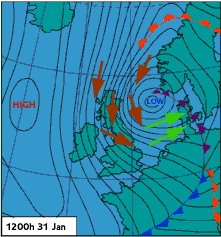
Pressure system hours before the 1953 flood, low 966 mb.
In summary, it should be a very high tide on the East coast next week but the forecast as it stands tonight does not suggest a dangerous event.
“Twice a year something special happens and the Sun and Moon become aligned and both pull in the same direction, reinforcing each other creating a spring tide (not named after the season but rather springs!).”
Err – no. Spring Tides are a routine occurrence, I think the twice-a-year effect you’re referring to is “equinoctial tides”.
Ah, quite right. I’ve edited the introduction, thanks. Spring tides occur twice each lunar cycle, the equinocrial or perigean spring tide is when this alignment coincides with the closest approach of the Moon to Earth on its elipitical orbit. The twice yearly highs are spring tides close to the solar equinox.
Today’s isobaric forecast has the depression moving through a bit faster with it’s centre over and then east of Denmark on Monday so I think we’re safe this time.
10th September is an even bigger tide.