Living on the Cusp

Living on the CuspFrom Friday 17th to Sunday 19th June 2005 I attended the Living on the Cusp seminar at Braziers Park in Oxfordshire, UK. The seminar was presented by Naresh Giangrande and covered peak oil, non-renewable alternatives to oil, renewable alternatives to oil, energy return on energy invested (EROEI), carrying capacity, ecological footprint, ghost acreage, exponential growth, Jevons paradox, Easter Island, St Mathew Island, the Cuban case study and personal and community responses. Naresh also provided a CD with a collection of essays, articles and presentations on the topics. The film End of Suburbia, Oil Depletion and the Collapse of The American Dream was also shown on the Saturday evening.

The course material was at times necessarily quite technical and detailed however Naresh succeeded in communicating the above topics in a clear and down to earth manner and ensured everyone understood before moving on. It’s not that carrying capacity or ghost acreage are particularly complex subjects to grasp, they just need a different way of thinking about the world to fully appreciate.

Attendance waxed and waned somewhat as resident community members balanced other work and the demands of children but approximately 8 people were usually present. The format was very relaxed with every opportunity for discussion as the material was presented.

Whilst little of the material was new to me, I gained a lot through discussions with the others who were very receptive to the material. Of particular interest was the Sunday afternoon session where personal and community response was addressed. At this point I need to say something about the Braziers Park community. Braziers Park itself is a ~£4million 17th Century Grade II* listed building in approximately 50 acres of Oxfordshire countryside. Since 1950 it has been home to a secular community of ~20 people (though numbers vary and the community edge is understandably blurred).

I think it is fair to say it is an aspiration of the Braziers community to become self sufficient and ecologically sound though by their own admission they are far from there currently. The motivation for this is two fold, firstly it’s just a generally smart thing to do from both economic and moral points of view but secondly and perhaps more importantly is the credibility this would provide. The community has a history in education and has a strong desire to expand educational activities, running seminars (like Living on the Cusp) and training courses. The energy crisis we are approaching is expected to stimulate demand in ecology, self sufficiency and alternative technology teachings and if Braziers Park is to offer training in this area they need to be seen to be living what they preach.

The responses ranged from the easy wins like rain water collection and comprehensive replacement of incandescent with compact fluorescents bulbs through to more ambitious projects such as replacing the oil fired central heating system. Looking wider there also seemed to be agreement that Braziers could and should have more influence on the wider community, running an out-reach programme, recognising that the transition to a more sustainable way of life can not end at your own front door and needs to involve the whole community.

From what little I saw of the community over the weekend I believe they have incredible potential. Braziers is currently dealing with the same everyday challenges everyone else is whilst aspiring to something better, I am very pleased to see people starting to take peak oil seriously and hope a successful transformation can be an inspiration to others. I wish them every success over what could be difficult times ahead.
Braziers Park

UK North Sea oil extraction falls 17%

The UK has already peaked. The rate of oil extraction from the UK portion of the North Sea is now in decline after peaking at 3.1 million barrels per day in 1999. The extraction rate today stands at 1.9 million barrels per day, almost 40% down from the peak of just six years earlier.

The Scotsman wrote (article reproduced on Rigzone.com) on Thursday 9th June 2005 that:

UK oil production fell by 17 percent year on year in March – a decline the industry said was at odds with renewed investment in the North Sea.

Output slowed as the region revealed more evidence of its maturing fields, with figures from the Royal Bank of Scotland showing that combined oil and gas was down 13.5 per cent on the period in 2004.
Rigzone

17% per year is an incredible rate of decline and testament to the advanced extraction techniques employed in the North Sea from day one. Large scale production in the North Sea didn’t start until the early Eighties, the North Sea’s cold, windy climate and the then great depths required sophisticated offshore technology and large upfront capital costs. Due to this high capital cost and relatively high interest rates at the time extraction rates were maximised rapidly to pay off the investment as soon as possible.

UK Oil Supply

As has been seen around the world the use of advanced recovery technology doesn’t generally increase the ultimate recoverable reserves but does increase the recovery rate. Extracting the same amount of oil in a shorter period of time results in a rapid increase at first, a high peak rate of extraction before declining rapidly. We are now seeing this rapid rate of decline in the UK.

This rate of decline, if it were to continue, will result in production falling to 20% of the 1999 peak in just seven years.

The article concludes:

The UK Offshore Operators Association has said that increased spend could half production decline to 7 per cent per year – extending the life of the North Sea. Investment has been put at GBP 4.31 billion for 2005.
Rigzone

Leaving us with 40% of 1999 capacity in seven years time, hardly a positive position.

In magnitude terms this 17% decline represents the loss of approximately 300,000 barrels per day. This is similar to the figure Iraq is planning to reduce it’s exports by:

Iraq plans to cut its oil exports by 15 per cent in the second half as terrorism and lack of investment take their toll on infrastructure.

The new export figures imply an export volume of 1.45m barrels a day, or 250,000 b/d below the contracts offered in the first half.
Financial Times

The reducing supply from just the UK and Iraq this year will leave the world half a million barrels per day short, putting immense pressure on existing suppliers who are struggling to meet increasing global demand already.

Crazy Heathrow Expansion

Draft expansion plans for Heathrow were published today. I can only presume they are serious and this is not someone’s idea of a joke. The proposals are for a third runway and a sixth terminal.

Expansion plans could see the annual number of passengers rise from 67m to 116m in 2030.
http://news.bbc.co.uk/1/hi/england/london/4612393.stm

This £7bn development would come after the fifth terminal, which is due to open in 2008 at a cost of £4.2bn.

What the authors of the plan seem not to be aware of is oil depletion. There is a very strong argument for peak oil within this decade. After peak oil, oil prices will rise significantly forcing the already struggling airlines out of the sky. That someone, somewhere thinks that Heathrow is going to need to expand to cater for increased traffic after 2010 is crazy, it shows just how ignorant of the problem so many people are.

Book Review: Powerdown, Richard Heinberg

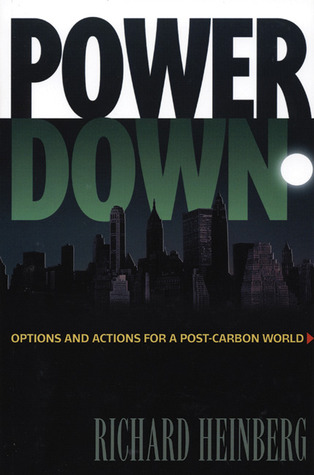
PowerdownI read Powerdown shortly after The Party’s Over, Heinberg’s earlier book on the subject of hydrocarbon depletion. The two books are very closely related with Powerdown containing many references to the other. For this reason I would not recommend Powerdown to anyone who hasn’t already read The Party’s Over or already has a good understanding of Peak Oil.

Powerdown doesn’t aim to convince the reader of Peak Oil theory. It is taken as read that oil depletion is upon us and sometime soon the rate of oil extraction will decline. For this reason anyone who hasn’t already accepted this may not get on well with book.

What the book does cover are four scenarios for the future given than less oil is going to be available in the near future than today. Briefly the four scenarios can be described as:

Last One Standing: resource wars to control what remains.
Powerdown: cooperation and conservation to manage oil depletion whilst maximising the remaining way of life.
Waiting for a Magic Elixir: waiting for a ’solution’ be it fusion, renewables, new discoveries etc… denial of the problem.
Building Lifeboats: accepting that the current way of life can not continue, we should act to preserve the best bits, preservation.

All points are well argued although Heinberg doesn’t hide his personal political opinions, I expect this could put off anyone with opposing political views.

The saddest thing about this book is that the two things we need to do (powerdown and preservation) aren’t being done whilst the two things that only amplify the problem are being done (resource wars and denial).

Anyone who’s read The Party’s Over should definitely read this. The arguments are tighter, more mature and thought out. It is clear that Heinberg has refined his analysis between the two books.

Highly recommended.

Powerdown, Options and Actions for a Post-Carbon World
Richard Heinberg
Paperback 224 pages (October 25, 2004)
Publisher: Clairview Books
ISBN: 1902636635

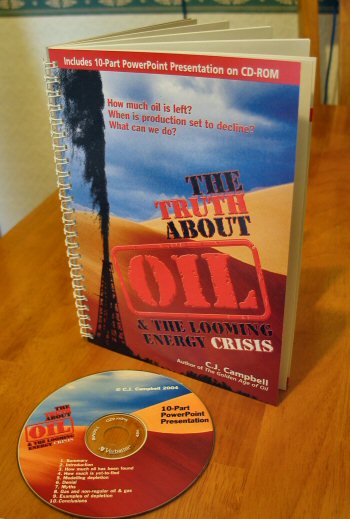
The Truth about Oil and the Looming World Energy Crisis by C. J. Campbell

After hearing about Colin Campbell’s most recent publication in the July ’04 ASPO newsletter I had to order myself a copy. This is what the newsletter had to say:

“A booklet by C.J.Campbell with the above title is now on sale from info@eagleoffice.net . It provides an outline of the subject in plain non-technical language, using the medium of an imaginary Public Inquiry to make the point. It includes a copy of the proposed Depletion Protocol that would better manage depletion, and a CD containing ten Power Point presentations complete with speaker notes. The booklet is aimed at the widest possible audience providing different interest groups, especially in the educational field, with the essential ingredients for lectures, courses, talks and presentations within their own spheres. The initial response has been very positive.”

I obtained my copy direct from Eagle Office, they don’t have the facility to take credit card payment on-line but phoning the number on the website was quick and easy, I spoke to Gemma who was very friendly. I placed the order on Monday (6th July ’04) afternoon and it arrived from Ireland to my UK address on the Wednesday. Total cost 21.75 Euro (~£14.50).

The booklet is A5 in size, spiral bound and comprises of 54 pages (46 excluding the contents, bibliography and references) and is printed in black and red.

The booklet addresses the topic of Peak Oil in a novel and refreshing way, as a commentary on an imaginary Public Inquiry. This commentary allows a vast range of opinions, facts and analysis to be covered in remarkably few words. This clear and efficient style makes it very readable and if distributed and publicised widely could reach a far wider audience than any 300 page book could.

The bibliography itself is very complete – the ultimate reading list for anyone interested in the subject.

I came to this publication having already read Deffeyes K. S., Hubbert’s peak – the impending world oil shortage and Heinberg R., The Party’s Over not to mention the majority of ASPO newsletters so it didn’t tell me very much new. The strengths of this publication are it’s accessibility to a wide audience. Certainly suitable to pass to friends and family.

Accompanying the book is a CD with 10 power point presentations. These are excellent. I have on a couple of occasions tried to create a neat, tidy, clear, structured presentation on this subject… without much success. Campbell has succeeded where I failed.

The final few pages contain current oil & gas production for 64 countries as well as forecasts out to 2050.

I feel the price is a little steep for something that has the potential to be so widely accessible. I have no idea how much it costs to self publish material like this. I expect it’s not cheap but it would be nice to see this available at Amazon for under £10. Drops half a star for the price but otherwise highly recommended.

The Truth about Oil and the Looming World Energy - Crisis. C. J. Campbell