UK Carbon Cuts ‘on track’

That was the headline today as the Government published its emissions score card for 2008 and so demonstrated that carbon dioxide (equivalent) emissions had fallen in line with the Climate Change Act’s carbon budget. The equivalent term just means that a whole bunch of greenhouse gases (inc. methane, nitrous oxide, hydrofluorocarbons, perfluorocarbons and sulphur hexafluoride) have been aggregated into units equivalent to CO2.

This is a good news story. Climate Change Minister Joan Ruddock is quoted in the press release:

Today’s emissions score card shows that the UK’s climate change policies are working and that we’re on track to meet our carbon targets.

We’re putting in place policies to make the low carbon transition by supporting investment in clean energy, in insulating homes and creating green jobs.

Call me a spoil sport, but I don’t buy it. One has to be careful when thinking about correlation and causation. I put it to you that the 1.9% decline in UK CO2e emissions from 2007 to 2008 was not in fact due to the “UK’s climate change policies” as Ruddock would have us believe but an inevitable result of the recession the country entered that year.

The Quarterly national accounts for 4th quarter 2008 (published 27th March 2009) can shed some light on the matter. The following charts show UK GDP growth, then the separate performance of the manufacturing and service sectors as we entered recession in 2008. Note the vertical scales are different.

UK GDP

UK Manufacturing and Service Sector GDP

Whilst total GDP growth for 2008 was still just positive for 2008 at 0.5% (the declines didn’t really manifest until the 2nd half of the year) this hides the fact that the relatively energy and carbon intense manufacturing sector was disproportionately hit by the recession.

I’m disappointed by the disingenuous (at best) way the Government is presenting the emission data. Claiming responsibility and credit whilst not recognising the surely highly significant role the recession has played in reducing UK emissions.

Looking forward, what can we expect? 2009 is very likely to show a further decline, strongly influenced by the continued decline in the economy. It is as I highlighted in a post a few months ago, economic collapse (as seen by the Soviet Union) is a tremendous way of cutting CO2 emissions.

I don’t think that is the climate change policy Joan Ruddock has in mind!

The UK “Oil Age” Begins

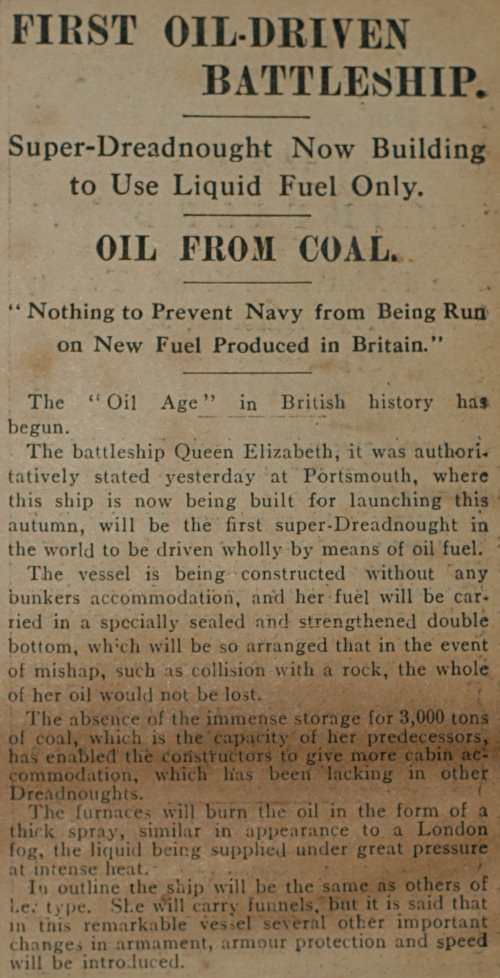
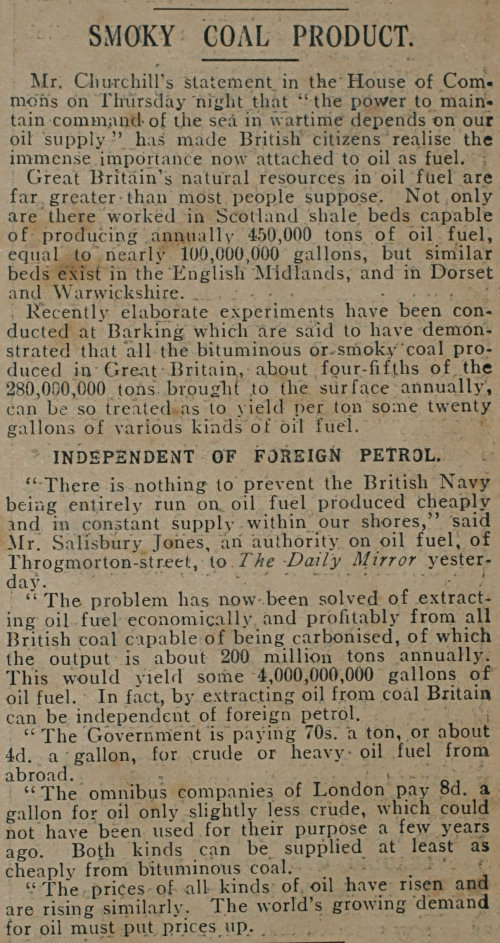
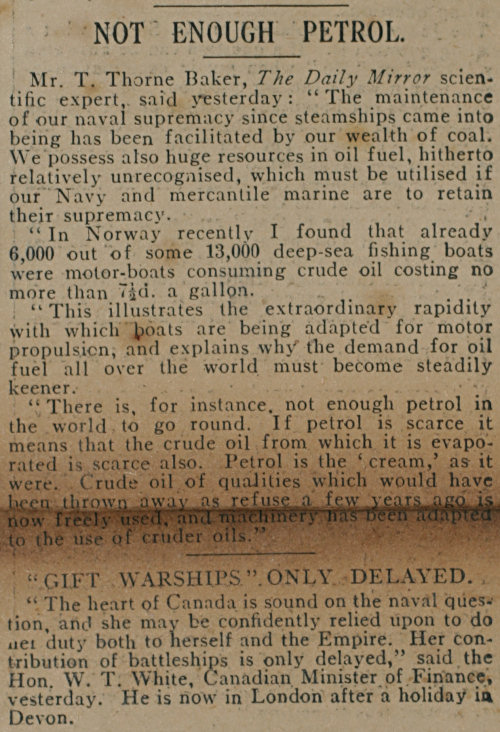
A couple of years ago I came across a single page from the Daily Mirror from 19th July 1913. It had been in the back of an old picture frame my mother was working on. This would have been interesting in itself but this 97 year old sheet of paper had a very interesting story about the construction of Great Britain’s first oil-driven battleship heralding the beginning of the “Oil Age”.

Winston Churchill underlines the military importance of imported oil, leading the discussion to the country’s potential self sufficiency in oil. Clearly this is decades before off-shore oil discoveries in the North Sea so shale beds are considered along with a recent breakthrough demonstrating how some 20 gallons of oil can be economically produced from a ton of coal.

Of course some things never change, growing world demand was even reported to be forcing up the price of oil in 1913. As it turned out the UK never embarked on economically significant coal to liquids programmes or exploitation of the shale resources.

Further information on HMS Queen Elizabeth is available here: Wikipedia


It’s an interesting coincidence that just as coal was being discussed as a future source of liquid fuel UK production was peaking. The all time peak production rate of UK coal was 1913:

UK Coal Production

UK Coal Production

UK Coal Production (D. Rutledge)

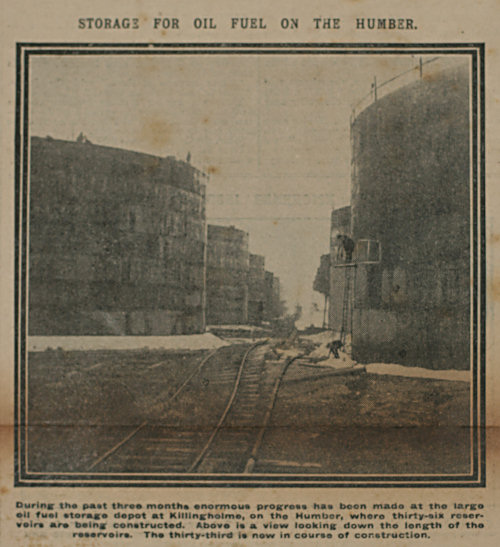
The image below shows the construction of an oil storage depot at Killingholme. Interestingly this is now the site of a large ConocoPhillips oil refinery, opened in 1969 and sited here as a good place to land North African crude. The simultaneous discovery of North Sea oil made it a highly successful venture now responsible for 10% of UK petrol and 14% of all other oil products.

High Tide Alert

Tides can be fairly dramatic, within hours the sea rises and falls several metres. Without them beaches would be a lot smaller. They are caused by the gravitational pull of the Moon and the Sun exerting a force on the water (and the Earth), first one way, and then the other. Twice each lunar month the Sun and Moon become aligned and both pull in the same direction, reinforcing each other creating a spring tide (not named after the season!). More rarely this reinforcement coincides with the Moon’s closest approach, the perigee of the elliptical orbit producing a higher spring tide called a perigean spring tide. The highest tides occur when the spring tide coincides with one of the solar equinoxes to produce a equinoctial tide.

I’m writing this on the evening for Friday 26th February after my father sent me a couple of web links. The first link was from the Proudman Oceanographic Laboratory in Liverpool and showed the tide table for the port of Immingham, about half way up the English east coast. The data is presented below. It shows a twice yearly high equinoctial tide is on the way (2nd highest of the year), with the highest height of 7.86 m due on the evening of Tue 2nd of March. The peaks on the 1st and 3rd are only ~10cm lower.

Immingham tide table

Immingham tide table. Proudman Oceanographic Laboratory.

The tides in the first link do not take weather into consideration. The actual height of the water on any given day is highly influenced by the strength and direction of the wind and the air pressure. Low pressure allows the sea to bulge up, high pressure depresses it. For every millibar decrease in air pressure, sea level rises by 1 cm, a deep 960 mb low raises sea level by half a meter from the average pressure of around 1013 mb (Met Office). Wind strength and direction has a greater impact though. Strong winds can push water towards the shore or funnel it into narrowing coastal features causing the tide to be higher than it would otherwise be.

The second link is where it gets interesting. It is a surface pressure forecast from the UK Met Office. As of this evening the T+72 hr chart which represents 0000h Mon 1st of March shows a low pressure area (~972 mb) in the southern portion of the North Sea. A first approximation suggests this represents a ~40 cm rise on top of the spring tide. I’ve reproduced the chart below. Clicking forward to 1200h on the Monday shows the low pressure area tracking a little eastwards.

Surface Pressure Forecast

Surface pressure forecast as of 26th Feb 2010.

The thing to remember about low pressure systems, or cyclones, is that the winds blow around them in an anti-clockwise direction (in the Northern Hemisphere). This means that, according to my crude interpretation of the surface pressure chart we can expect the winds to be blowing either towards the coast or perhaps more seriously down the North Sea from the north east funnelling water southwards. This wind and pressure system look to be reinforcing the spring tide and could result in an exceptionally high tide next week.

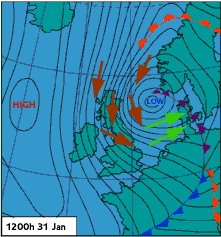
Disclaimer: I am no expert in this kind of analysis. This short post represents the limit of my understanding and three days out the track and intensity of this low pressure system could change significantly. However it’s worth remembering that the disastrous North Sea flood of 31 Jan – 1 Feb 1953 where 1,835 people were killed in the Netherlands and 307 in the UK, followed a similar combination of spring tide reinforced by a low pressure system. In that event the pressure was a little lower, dipping to 966 mb and the centre approached from the north (pulling water with it) rather than the south as is the case today. An additional contributing factor in 1953 was a ridge of high pressure (1030 mb) south of Iceland, the large pressure gradient driving high winds (Met Office). Today there is no such high and very strong winds seen in 1953 are not expected. It should also be noted that sea defences both in the UK and the Netherlands are considerably better than in 1953, an identical meteorological event should not be as dangerous today.

Presure 31 Jan 1953

Pressure system hours before the 1953 flood, low 966 mb.

In summary, it should be a very high tide on the East coast next week but the forecast as it stands tonight does not suggest a dangerous event.

Sea Level Rise, London

Sea level rise is one of the most serious consequences of climate change. This is largely due to the fact that large concentrations of people live on the coast, approximately at sea level. There is also a public communication issue here as the science talks of mm per year. It’s hard to get excited about 3.1 mm/yr (1993-2003, IPCC) when tides move metres in hours. The current rate is probably closer to 4 mm/yr given the acceleration in ice-sheet melt since then. Instead of being scientific, let’s be dramatic, let’s look at London today.

Thames_1

It’s actually Sunday afternoon on the 31st January 2010. I happened to be in Putney on the banks of the river Thames and was surprised to watch the river come over its banks and flood the nearby road. By the look of the parked and flooded cars I wasn’t the only surprised onlooker that afternoon.

I managed to take a few photos on my phone. The photos were taken between 15:08 and 15:12, high tide was officially 15:16 in Putney that day so this was pretty much it. A Putney tide table is available here: http://tides.rjen.me.uk/

The site contains a tide table for Putney Bridge, just a few hundred metres from where the photos were taken (visible in the second shot). The table says the projected high tide height was 7.4 m, certainly a high tide but the projection for the following day was 7.5 m and scanning down the table every ~28 days high tides exceed seven metres for a few days at a time. I don’t believe this high tide was contributed to by particularly strong easterly winds, low air pressure or high proceeding precipitation in the Thames catchment area. This is normal, London and its millions of inhabitants live at sea level. There isn’t much margin to accommodate the potential 1 m (or possible as much as 2 m) sea level rise the science is indicating could occur by 2100, 90 years from now.

The only point to keep in mind is that this road, The Embankment, is the ‘wrong’ side of what flood defences do exist. In some ways it could be said to give a more accurate impression of how vulnerable London is. Were it not for the hard engineered flood defences many more roads would regularly look like this. The map at the bottom of the page is from the Environment Agency (click here for dynamic version). It shows these hard defences in pink and the areas at risk of flooding without defences.

The long term view, several hundred years, could easily see sea level rise of several meters. At which point cities on tidal estuaries like the Thames are unlikely to be viable. What should one do today, if one believes much of London to be uninhabitable in several hundred years time? How much should be invested to protect the city for the next hundred or two hundred years, if its loss four hundred years from now is inevitable? Of course these numbers are just educated guesses but the question is a serious one.

Thames_2

Thames_3

Thames_4

London flood map from the UK Environment Agency

Why The Tories Won’t Win The 2010 Election

Any day now Gordon Brown will announce the 2010 election. Following the discussions and analysis in the media one might be forgiven to wonder why we’re even bothering with an election. The expectation is for a clear Tory victory. The bookies have certainly made their mind up offering odds of just 1/12 for a Conservative win and 6/1 for Labour. However this may be as much a reflection of perceived public opinion as the book makers expert opinion of probability.

Houses of Parliament, Chris Vernon 2008

Houses of Parliament, Chris Vernon 2008

I don’t buy it. Whilst the Labour and Conservative parties receive similar coverage on the media, giving the impression of equal standing, the electoral reality could be quite different. Due to the vagaries of our first past the post electoral system and constituency boundaries, approximately equal share of the public vote doesn’t come close to delving approximately equal numbers of seats.

There are 646 Members of Parliament today, rising to 650 in 2010. To form a government David Cameron would need a majority, 324 seats of the old parliament, 326 in the new. He currently has 193 so needs a minimum net gain of 131 seats (68% more than today) based on the current 646, 133 in the new. Labour currently have 352 seats. Quite why we need four more MPs, which I guess will cost around a million pounds a year between them escapes me.

In 1997 Tony Blair’s Labour party overturned an 18 year Conservative government with a landslide victory. Labour won with 418 seats the most they had ever held and the Tories were left with just 165, the least they had held since 1906. This dramatic result came about as Labour won 147 seats and the Tories lost 178. Percentage wise, Labour only increased their seat count by 54% though. Before the 1997 election, the Labour Party was a lot stronger than the Conservative Party is today.

Ignoring the additional four seats, in the 2010 election Labour will lose the majority if they lose 29 seats. Quite possible. For the Tories to win however, they need 131 more seats. Far trickier. Adding to the Tory challenge is that independent candidates are likely to win more seats than usual as celebrities and local heroes stand against members damaged by the expense claims fiasco. National parties (like SNP and Plaid Cymru) are also likely to do better than before as part of a broader backlash against Westminster.

Of today’s 646 seats, 30 are are held by national parties, small parties or independents. I expect this figure to rise, reducing the pool available to the big three parties from which to achieve their overall majority.

Since the 2nd world war, the party of government changed seven times:

1945 Conservative to Labour, Labour gaining 239 seats (+155%)
1951 Labour to Conservative, Conservative gaining 22 seats (+7%)
1964 Conservative to Labour, + 59 seats (+23%)
1970 Labour to Conservative, + 69 seats (+27%)
1974 Conservative to Labour, + 13 seats (+5%) Hung parliament, Labour short of majority.
1979 Labour to Conservative, + 62 seats (+22%)
1997 Conservative to Labour, + 141 seats (+54%)

The Tories have a mountain to climb. 131 additional seats, 68% more than today (just for unworkable majority of one), in an environment where the main parties are likely to suffer relative to smaller parties and independents. I think a Tory victory is unlikely. However, Labour maintaining their majority with only 28 seat buffer also seems unlikely.

In my opinion the most likely outcome of the 2010 election is a hung parliament with no party holding a clear majority. Whether Cameron or Brown will have the most seats is harder to say but I would guess Brown’s Labour might just hang on to form a coalition government. I also believe this to be a good thing. The challenges ahead of us are too large to get bogged down in party political squabbling. A coalition government might be able to see past the relatively minor differences between parties and better face the extreme, economic, environmental and energy problems we face.

My analysis above is certainly simplistic. The bookies (with millions of pounds riding on it) seem to come to a very different conclusion, no doubt after far more sophisticated analysis but I just have a hard time believing it.

Only time will tell.

Should we Geoengineer the Climate?

Last week, the Royal Society held a public lecture entitled ‘Geoengineering the climate: A brave new world?’, following their September 2009 publication ‘Geoengineering the climate: Science, governance and uncertainty’. The lecture panelists, like the authors of last year’s publication, were from a wide range of disciplines, reflecting the diversity of issues which arise from geoengineering proposals.

Some of the proposed methods for geoengineering the climate

Geoengineering solutions for combating global warming fall into two broad categories. The first, Carbon Dioxide Removal (CDR), addresses the principal cause of climate change by removing CO2 from the atmosphere, and so reducing the greenhouse effect. The second, Solar Radiation Management (SRM), involves countering the warming effects of high atmospheric CO2 by reflecting some of the radiation from the sun.

Examples of suggested CDR techniques include biochar; aforestation; ocean fertilisation; and enhancement of weathering. SRM methods include increasing the albedo of the earth, such as by painting building roofs white; increasing the reflection of radiation from the stratosphere by releasing aerosols; and space-based methods which reduce the amount of radiation reaching the earth, such as by launching reflectors into space.

The immediate benefit of CDR over SRM is that it removes CO2 and so would counter ocean acidification (and other CO2-related problems), whereas SRM only prevents warming. However, some methods for SRM could be deployed very rapidly, most CDR methods would take years or decades to become effective.

The only panelist who opposed any further research into geoengineering was Greenpeace senior scientist Dr. David Santillo. The opinion of Greenpeace, and of many other opponents, is that focussing on geoengineering solutions to the climate problem diverts attention (and funds) from what is sometimes termed ‘Plan A’: the reduction of CO2 emissions. The possibility of a ‘Plan B’ may be regarded by governments, industry and the public as an excuse to continue burning all remaining fossil fuel reserves. An uncertain cure in the place of a more reliable prevention.

However, it can not be assumed that all serious advocates of climate geoengineering see it as an alternative to emissions reduction, but rather as a necessary additional measure. This is the logical conclusion from the increasingly popular view that present levels of atmospheric CO2 are already so high that certain tipping points in the earth climate system have been reached (most recently). This position asserts that even if emissions fall to zero tomorrow, ‘catastrophic climate change’ is still probable.

The problems with geoengineering are wide-ranging and hard to predict, but stem from three main areas:

Firstly, designing successful methods to reduce either atmospheric CO2 levels, or solar radiation absorption require an excellent understanding of the earth system. At the Royal Society, Professor Corinne Le Quéré, from the University of East Anglia, reminded us that current models are still not accurately reproducing observation in a number of fields, Arctic ice melt, for example.

Secondly, implementation of the technology itself could prove prohibitively expensive. This is certainly the case with space-based SRM methods. As well as monetary costs, implementation of some technologies may be expensive in terms of space and resources. Aforestation, for instance, risks competing for fertile land with agriculture.

Thirdly, and perhaps most critically, major geoengineering projects would require international cooperation. Although some CDR techniques, such as biochar and land use changes, could be applied in specific areas, without need for consent from others, they would actually need to be implemented across large areas of the world to be effective. Certain SRM techniques, however, could be carried out by one country (perhaps by releasing aerosols into the stratosphere), and would be effective over the entire globe. This category of technique could be damaging to the climates of certain parts of the world, for example by reducing precipitation. Added to this is the fact that once a particular SRM is started, it will have to continue indefinitely. If suddenly terminated, rapid warming would commence, with disastrous consequences. After the recent failure of world leaders to agree upon emission reductions at Copenhagen, how can we rely upon them to reach an agreement over the much more complex issue of geoengineering?

Plan A may have already failed, plan B is not a silver bullet solution, which leads me to consider plan C: Adaptation. Millions, perhaps billions of people are at risk of being displaced by sea level rise, drought, famine and other effects of climate change. Humankind has adapted to changes in climate before, by migrating, by changes in behaviour, and by inventing new technologies. With a population of nearly seven billion, the task is certainly tougher this time. But perhaps it’s the most feasible option left to us.

Science and the Media

I recently attended the QRA annual conference in Durham. For three days we mostly discussed sea level rise, and the large quantity of snow under foot (Durham was blanketed in six inches of snow for the whole week). One session was on science and the media. Here was a room of over a hundred scientists representing millions of pounds of public research money, what was our relationship with the public?

In a far ranging discussion here are a few points that stuck out to me:

Despite many years of training few scientists have training to understand the media. This is becoming well recognised and most universities are starting to offer training, especially for their more prominent academics but it remains the exception rather than the rule. A book that I think all scientists should find time to read is “Don’t be such a scientist” by Randy Olson. It was recently reviewed on Real Climate.

Journalists tend not to have subscriptions to scientific journals, they literally can’t see our science. Even if they could, many papers would remain illegible due to the specialist terminology and assumed knowledge. A proposal from the floor was for journals to require from paper authors a “layperson version” of the paper. It could be a short summary, written for a general audience, with a figure or two. This would be available on the journal’s website for free providing much needed public content for the journal and a way for the core message of the science to find a wider audience.

There exists a tension between knowledge and uncertainty. Too often specialists aren’t willing to give the certainty media craves. The situation may arise where an editor has a story, they phone their pet scientist, known and trusted for advice. Most likely is that the scientist won’t be the expert so will refer the editor on to someone else. Someone the editor doesn’t know and doesn’t have time to develop a relationship with. There’s a four-hour deadline after all. The point is the editor only needs to know the general stuff and the scientist probably knows enough, more than the editor anyway. If the scientist refers the editor either the true expert will baffle the editor with way more information than they need or the editor will just write up the story themselves. We should be braver, run with what we do know, with caveats if need be. The expert fine detail isn’t always required or even desirable.

NASA climate scientist James Hansen makes a very good point in a 2007 paper:
Scientific reticence and sea level rise

Reticence is fine for the IPCC. And individual scientists can choose to stay within a comfort zone, not needing to worry that they say something that proves to be slightly wrong. But perhaps we should also consider our legacy from a broader perspective. Do we not know enough to say more?

One fascinating question to the room was how many have written on the web, a blog or Wikipedia? Only a few admitted blogs, no one raised their hand to Wikipedia. Scientists tend only to publish in peer-reviewed journals, however the general public and the media don’t read them. Oops. They read the web but scientists aren’t writing on the web! In a room full of sea level rise experts none had contributed to the Wikipedia article on sea level rise. Who had written it!? There is no encouragement or recognition for scientists to communicate in the forum most people get their information from. I will keep writing this blog!

The discussion did come back to sea level rise, what image represents sea level rise? Shouts included Katrina, Tuvalu etc. however it was pointed out these examples are scientifically controversial. The problem is how do you communicated mm per year without using these emotional, controversial images? It’s a scale issue. The science works on scales that people aren’t interested in. People care about weather not climate. The useful response was to reframe mm per year into insurance premiums, 200-year flood events becoming 50-year events and so on. Same science but human language.

Predictably the media’s treatment of climate change with 50:50, “balanced” debates was raised. Journalists are trained in politics, economics and law where there are often two sides worthy of equal coverage. Journalism is all about finding the other point of view, it simply doesn’t handle science well. It was suggested that the BBC at least is improving in this area now.

Whist the debate focused on science and the media, the actual decision makers with respect to sea level rise at least, are often local government. There doesn’t seem to be much of a communication channel between the sea level scientists and local governments at all.

Finally, The Oil Drum was founded by a couple of US academics [edit: see 2nd comment]. Key to their motivations was dissatisfaction with the traditional academic publishing process. It simply took too long to go from idea to published paper and once published few people read it. Blogging reduced a process that took months, to days or even hours and increased eyes by an order of magnitude or three. Blogging also enables academics to more easily write outside their recognised specialism.

Bread

BBC Radio 4’s Food Programme was about bread this week. I guess it’s still available to ‘listen again’ for a while. They were reporting from an Oxford conference titled The Rise of Real Bread. To quote the flyer:

Nothing, but nothing, is more important than bread. Truly it is the staff of life.

Yet the majority of Britain’s bread is highly processed, packed with additives and designed to be as cheap as possible with the emphasis on shelf-life rather than on nutritional quality and flavour.

This day looks at the food supply chain behind Britain’s mass-produced bread and asks whether it could be improved. Can we support local farmers, millers and bakers to grow and bake with better crops and in turn make good, natural bread accessible to all?

The conference was organised by The Real Bread Campaign. The programme makes the point that bread is important, has been at the heart of food and therefore the heart of society for centuries. It is also simple, only contains flour, water, yeast and a small amount of salt. The community aspect was stressed as much as the actual product. The bread discussed was made by local, community bakeries and in one case distributed by the local pub! Bread making was described as a craft.

These artisan breads aren’t cheap though, over £2 a loaf in many cases. Perhaps twice the price of a supermarket 800 gram, but it was suggested by one foody academic that apart from the very poorest in society the majority are more and more buying food on value rather than absolute cost. I can believe that.

Well, with my new found enthusiasm I had a go. Here’s loaf number one:

First loaf

I don’t have a loaf tin (yet) so it’s rather blob shaped. Smells and tastes great, so far so good!

After COP15: Boycott China

Now that life has returned to normal on the streets of Copenhagen and we have had time to consider the Copenhagen Accord it’s time to work out what to do next. Here’s my take on it.

Mark Lynas wrote an interesting piece for the Guardian from an almost unique position he found himself in last week. He was one of only ~60 people in the closed doors heads of state meeting at the end of COP15. Media were not allowed, Lynas was there as part of the Maldives delegation. There won’t be many reports from this meeting.

It has emerged that China (with a degree of backing from India and Saudi Arabia) were chiefly responsible for the failure at COP15. The majority of the rich nations, including America wanted a much tougher deal but China vetoed it.

To those who would blame Obama and rich countries in general, know this: it was China’s representative who insisted that industrialised country targets, previously agreed as an 80% cut by 2050, be taken out of the deal. “Why can’t we even mention our own targets?” demanded a furious Angela Merkel. Australia’s prime minister, Kevin Rudd, was annoyed enough to bang his microphone. Brazil’s representative too pointed out the illogicality of China’s position. Why should rich countries not announce even this unilateral cut? The Chinese delegate said no, and I watched, aghast, as Merkel threw up her hands in despair and conceded the point. Now we know why – because China bet, correctly, that Obama would get the blame for the Copenhagen accord’s lack of ambition.

China, backed at times by India, then proceeded to take out all the numbers that mattered. A 2020 peaking year in global emissions, essential to restrain temperatures to 2C, was removed and replaced by woolly language suggesting that emissions should peak “as soon as possible”. The long-term target, of global 50% cuts by 2050, was also excised. No one else, perhaps with the exceptions of India and Saudi Arabia, wanted this to happen. I am certain that had the Chinese not been in the room, we would have left Copenhagen with a deal that had environmentalists popping champagne corks popping in every corner of the world.

So we have a situation where a large proportion of the world does want a tough and legally binding deal on climate, but the unanimous nature of the UN’s COP15 process does not allow that to be recognised. This need not be a cause for despair though as it’s not a unique situation.

There are many situations in the world where unanimous agreement cannot be reached. Rogue states exist.

Two relevant examples are the current situation with Iran’s apparent nuclear ambitions and historically South Africa’s apartheid regime. In each of these cases we have one state doing something that the majority of the world has agreed not to do. There’s the nuclear non-proliferation treaty, which although Iran is a signatory is also in non-compliance with the safeguards. The US maintains sanctions with wider adoption under discussion.

The first UN resolutions addressing apartheid were passed in the early 1960s and by the early ‘80s many countries had placed various trade sanctions on South Africa.

The situation with China and climate change is similar. It’s one ‘rogue state’ going against the global consensus. A unanimous agreement is currently impossible (as it also seems to be regarding Iran’s nuclear ambitions and was with the apartheid regime in the ’60s). I believe the solution is for a ‘coalition of the willing’ to form (comprising of the EU, US, Australia, most of the developing world…), for it to construct a legal framework delivering emission cuts of ~20-30% by 2020 and ~50-80% by 2050. These kinds of numbers do seem politically feasible when China and friends are excluded.

Part of the coalition’s approach to meeting the targets might be carbon intensity import tariffs, to penalise China’s exports. The role of civil society, environmental groups etc. is to lobby for such legislation and to campaign for a boycott of Chinese goods. The two approaches cover the top-down and bottom-up angles, they penalise the Chinese high carbon economy and promote lower carbon, locally produced products. Win-win?

Is there evidence of boycotts actually achieving things in the past? Nestlé is widely boycotted but seems to be doing okay.

Maybe I should start a Facebook group? Seems to be the way things are done these days!