Live Below The Line

Last week we decided to join in with awareness raising campaign Live Below The Line. The main aim of the campaign (apart from fundraising) is to draw attention to the many people living below the “poverty line” (in the UK equivalent to £1 per day on food), and the challenge was to do the same, spending under £1 per day on food. Of course, it is not meant to be in any way comparable – someone “living below the line” for real would have a limited budget which would have to do for not only food but also toiletries, lighting, heating, cooking, accommodation, clothes, shoes, travel, medicine, etc. – but to be thought-provoking and challenging. We’re not the types who would normally spend £3 on a cup of coffee or eat out more than occasionally, but we certainly have the luxury of not needing to worry about the cost of food.

So, how did it go?

Well, we started badly by being away from home the week before and having a power cut on Sunday, so were rather distracted from our preparation which meant that we had to do our shopping on Monday morning, at Tesco. We have taken some flak for going to Tesco (more on that later) but we were unsure at that point whether we would manage the challenge, so prioritised quantity per penny and made full use of the Tesco Value range:

Shopping

Shopping

Total spent £8.90. The garlic (23p) and 1 onion (14p) were purchased separately and the homemade jam we worked out at 11p per 100g. We were pleased to have some money left over for oil and seasonings etc, which we priced pro rata, and we allowed ourselves produce from the allotment at a total of 37p for the week (£37 per year, 5% of area, 1/5 of annual produce – a debatable calculation but I think reasonable). Catch of the day was the celeriac, reduced to just 20p.

Monday breakfast: 90g oats and 18g jam, 7.5p

Then we made some bread (500g flour, 7g yeast and 5g salt, total 30p), of which we had a couple of slices each for lunch with 1/4 tin of tuna (11p) and a couple of biscuits (0.62p each):

Bread

Bread

Dinner (51p) included a sixth of a vegetable stew (1/2 celeriac, 500g carrots, 100g onion, 3 cloves garlic, 20g oil, 1/4 celery pack, 1 tin beans, 2 cartons passata, total £1.39), which we made on Monday and which provided Tuesday’s lunch and dinner as well. Rice portion 6p each. For dessert we had some rhubarb from the allotment. Also from the allotment was a delicious starter of asparagus, which was eaten before it could be photographed…

Monday

Monday

Tuesday breakfast: We had budgeted for 100g oats each per day for breakfast, but this did turn out a bit too much and we ended with some left over!

Lunch was leftovers for Chris (30p), and two tuna sandwiches for Erica (20p).

For dinner we started on the potatoes: we used 1.5kg (54p) for chips with a little oil (4p). Half of the chips were saved for tomorrow’s lunch and half served up with the remains of yesterday’s bean stew (45p) and 225g of the green beans (17.5p). Rhubarb followed. Divide that by two for the cost per person and here it is:

Tuesday

Tuesday

Wednesday lunch was chips and bean stew and a couple of jam sandwiches (30p) for Chris, which adequately fuelled his day of volunteering with a bicycle maintenance scheme. Erica finished the tin of tuna with the bread (and perhaps a couple of sneaky chips from the fridge) (20p).

Wednesday dinner was dal (500g yellow split peas, most of the rest of the garlic, 5g cumin seeds, 30g oil, <1g chilli, 1/2 onion, 1/2 celery pack, 2 carrots, total £1.21) with rice (6p each) and more green beans (12p). We started eating before remembering to take a picture: [caption id="attachment_808" align="aligncenter" width="600" caption="Wednesday"]Wednesday[/caption]

Thursday lunch and dinner were both more dal and rice, with green beans at dinner again:

Thursday

Thursday

On Friday morning we realised we had slightly miscalculated and should have cooked the previous night, so had to do it in the morning to avoid having to buy bread for lunch. We made another bean stew (135g onion, last of garlic, 25g oil, 1/4 celery pack, other 1/2 celeriac, other tin kidney beans, 3 carrots, 1 carton passata, total £1.06) and baked 11 potatoes. We each had 3 potatoes and some stew for lunch and Chris made some more bread (30p see above). Dinner was the rest of the stew and potatoes:

Friday

Friday

So we ended up staying just within the budget, but having a fair amount of food to spare. We didn’t use any of the plain flour (52p) or the tinned spaghetti (14p), and we had quite a lot of potatoes and carrots left over from the big packs, as well as some oats and green beans. In nutritional terms we did just fine on calories but probably were a bit over-reliant on carbs – and we also realised afterwards that there was almost no fat in anything we had except for the oil for frying, so it might have been sensible to use the slack for something like a bit of milk.

We were surprised to find the budget quite so easy to live on, and felt the main challenge was planning carefully. It was a bit strange to see some people posting on the LBTL Facebook page saying that they were going hungry or had only a carrot for dinner – I think these people relied a bit too much on over-processed “cheap” food which actually turns out not to be so cheap when you realise how little nutritional value it has. And those who insisted on having the non-negotiable meat and dairy products in their diet also seemed to trade off very heavily on calories, despite picking the most revolting sausages available(!) and the factory farmed eggs.

Returning to our own trade-offs, however…. as has been said above, yes we did go to Tesco and yes we did buy the non-organic exploited unethical veg while we were there. We thought this would be necessary but in retrospect we believe we were enough within budget that it would have been possible, but only just, to buy organic versions of some of these.

Whilst this has been an interesting exercise we feel an important point has been missed by many. The low price paid for food in the west (aka Tesco Value) is a form of exploitation and at least partly responsible for much of the world’s poverty. For example, the average U.S. consumer spent 9.8 percent of disposable personal income (income available after taxes) on all food in 2007, a figure that has fallen from 14% in the 1970s (ref). In the UK it’s around 15%, half what it was 50 years ago (ref). For those who are able, paying a fair price for food is part of ensuring that we can continue to support our farmers through the tough times ahead as agricultural inputs (based on fossil fuels) inevitably increase in price. Choosing organic and local, low-fuel-input foods is obviously an even better way of mitigating this problem by helping farmers move to more sustainable agricultural practices, securing a more affordable food supply in the long term. For our food future Tesco Value is part of the problem, not part of the solution.

Our next challenge will be to repeat the exercise, but restricting ourselves to organically grown and fairly traded produce. Fairly traded here doesn’t mean just “Fair Trade” branded but includes western countries with good labour laws. At the moment, these are often more expensive, so it will certainly be more of a challenge but one more relevant to the future.

We haven’t pestered anyone for donations, but if you’d like to help the charities who organised this campaign you can do so here.

Shopping Bill

Shopping Bill

Additions:

37p allotment produce (asparagus and rhubarb)
7p for 100g of sugar for stewing rhubarb
23p garlic
14p other onion
45p tin tuna
14p for 105g oil
0p for the last of some dried chilli from the garden from last year (<1g) 22p for 200g homemade jam 4p for 5g cumin seeds 11p for 14g yeast 0p for 10g salt ---- £1.78 Subtractions: 14p tin spaghetti unopened 52p plain flour unopened ---- 68p Total spent £9.99 (!) Leftovers (approx): 2kg potatoes, 800g carrots, 500g bread flour, 200g green beans, 150g oats, and a few biscuits! (about £1.50) making our actual daily average around 85 pence.

Allotment Update No. 14

Follow the allotment series here.

Two reports, first from this weekend (1st May 2011) and below an update from 17th April.

1st May 2011
We are not alone! Not only did we have some very helpful friends digging, sowing and watering (thanks!), but we also discovered some interesting wildlife. Here’s the movie:


Turns out it was a vole! Here’s some more info on the critter.

The main task for today was to plant out the sweetcorn. We had around 60 plants raised in a propagator over the last two weeks.

Sweetcorn

Sweetcorn, 1st May 2011

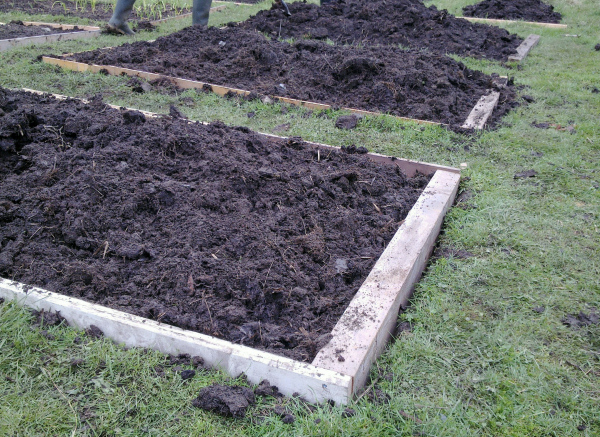
Over winter we’ve had some black plastic laid over a 5.5 x 2m area. It’s done a pretty good job of killing the grass so the soil just needed digging over with added manure.

Sweetcorn bed

Sweetcorn bed

Despite trying to block any rabbit sized gaps in the fence, they are still finding their way in. All we can do is net the tasty leaves.

Sweetcorn bed

Sweetcorn bed, with netting

We also planted more carrots and beetroot, around a month after the first sowing, and a couple of kindly donated pumpkin plants (thanks guys!). The potatoes continue to grow at a remarkable pace, they are now far larger than the two week old photo below.

17th April 2011

We had been away for two weeks before today, all we could be sure of was that it would be dry! March and April 2011 have turned out to be amongst of the drying ever in the England: Farmers Weekly

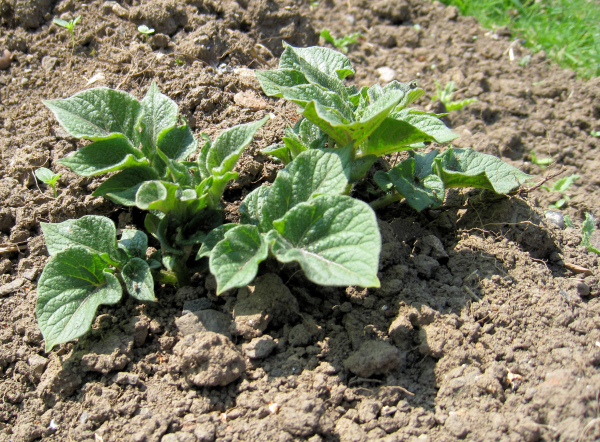
Potato

Potato, 17th April 2011

The potatoes are really impressive, this photo was taken 28 days after planting on the 20th March.

Garlic

Garlic

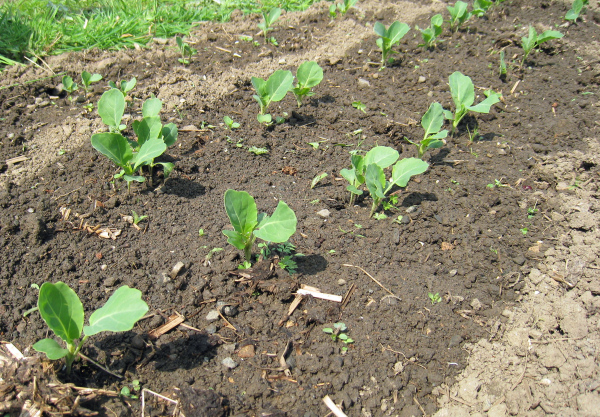
The garlic, planted last year is doing well as are the cabbages:

Cabbages

Cabbages, 17th April 2011

They have since been nibbled by the local rabbits so we’ve now got them under netting.

As we’ve only had around 20% of the normal rainfall over the last two months everything is dry. We’re finding the two biggest challenges to be watering (we’re using a couple of hundred litres every two or three days) and the rabbits.

Allotment Update No. 13

Follow the allotment series here.

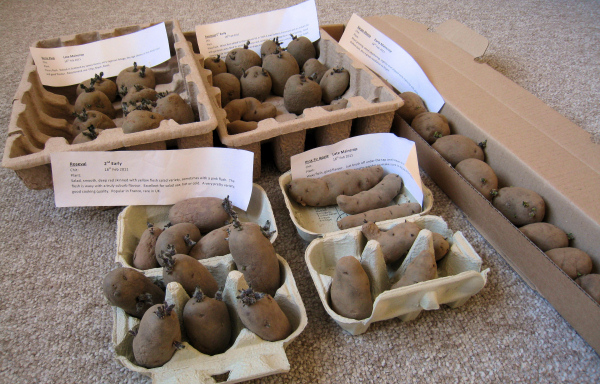
It’s been a while since the last update, with the improving weather a lot’s been going on at the allotment. On the 18th February we started chitting the potatoes. Four weeks later, there had been some progress:

Chitted potatoes

Four weeks chitting, 18th Feb to 20th March

The ‘before’ image is here: 18th Feb.

Of our five variates, Foremost (1st Early), Roseval (2nd Early), Sarpo Shona (Early Maincrop) and Kerrs Pink (Late Maincrop) have chitted nicely, ready to plant. Pink Fir Apple (Late Maincrop), however, hasn’t done much. There are some shoots but not ready for planting yet. We’ll give it another couple of weeks.

Chitted potatoes

Chitted potatoes, 20th March 2011

Here they are going in; the earlies are spaced 30 cm apart in rows around 40 cm apart and the rest spaced 40 cm apart.

Potatoes

Potatoes going in, 20th March 2011

Potatoes

Potatoes going in, 20th March 2011

We’ve also been improving the rabbit proofing, adding chicken wire to the gate, fixing a bit of fence, blocking up holes… it’s not obvious where they can get in now.

This weekend (26th March) we’ve been busy planting, and weeding. The thistles have the potential to be a problem. The meadow before we started digging was full of thistles and their remaining roots are spawning babies everywhere!

We added some more parsnips and cabbage, a few weeks after the first sowing. Sown the first time this year are: carrots, turnips, beetroot, bunching onions and leeks. We also dug a new bed along the fence and sowed a mixed pack of wild flower seeds.

Seed beds

Seed beds


From top to bottom in the photo: carrots, beetroot, parsnips, potatoes and cabbage with more potatoes in the top left.

Japan Earthquake, 11 March 2011

Seventh or eighth largest earthquake ever recorded, largest to hit Japan (according to Sky News).

From United States Geological Surveys (USGS):

The 03/11/2011 earthquake (preliminary magnitude 8.9) near the east coast of Honshu, Japan, occurred as a result of thrust faulting on or near the subduction zone interface plate boundary between the Pacific and North America plates. At the latitude of this earthquake, the Pacific plate moves approximately westwards with respect to the North America plate at a velocity of 83 mm/yr. The Pacific plate thrusts underneath Japan at the Japan Trench, and dips to the west beneath Eurasia. The location, depth, and focal mechanism of the March 11 earthquake are consistent with the event having occurred as thrust faulting associated with subduction along this plate boundary. Note that some authors divide this region into several microplates that together define the relative motions between the larger Pacific, North America and Eurasia plates; these include the Okhotsk and Amur microplates that are respectively part of North America and Eurasia.

The March 11 earthquake was preceded by a series of large foreshocks over the previous two days, beginning on March 9th with an M 7.2 event approximately 40 km from the March 11 earthquake, and continuing with a further 3 earthquakes greater than M 6 on the same day.

The Japan Trench subduction zone has hosted 9 events of magnitude 7 or greater since 1973. The largest of these was an M 7.8 earthquake approximately 260 km to the north of the March 11 event, in December 1994, which caused 3 fatalities and almost 700 injuries. In June of 1978, an M 7.7 earthquake 35 km to the southwest caused 22 fatalities and over 400 injuries.
http://earthquake.usgs.gov/earthquakes/eqinthenews/2011/usc0001xgp/[/a>

Aftershocks from the Japan Earthquake

Aftershocks from the Japan Earthquake

Allotment Update No.12

Follow the allotment series here.

This weekend we’ve dug another three beds… and started planting! Well, a few cabbage seeds went in on the 19th Feb and today we added a third of a bed of parsnips. The rest really need to wait until the risk of frost has passed.

Parsnip seeds

Third of a bed of parsnips sown, 5th March 2011

Our allotment neighbour very kindly gave us a few rhubarb crowns today. Very much appreciated, they went straight into a well manured bed we had previously earmarked for courgettes.

Rhubarb

Donated rhubarb crowns, planted 5th March 2011

We’ve also been collecting wood. Both from skips and Freecycle. Last weekend we got it down to the allotment to make edges for the beds. The earliest beds were dug last summer and gradually the grass has been reclaiming them, one was around six inches narrower! These edges should hold the grass at bay.

Allotment bed

The end pieces are old beams, 6x3, with planks running along the sides.

Allotment beds

A little neater now, the grass should be more manageable.

Willow Harvest at Radford Mill Farm

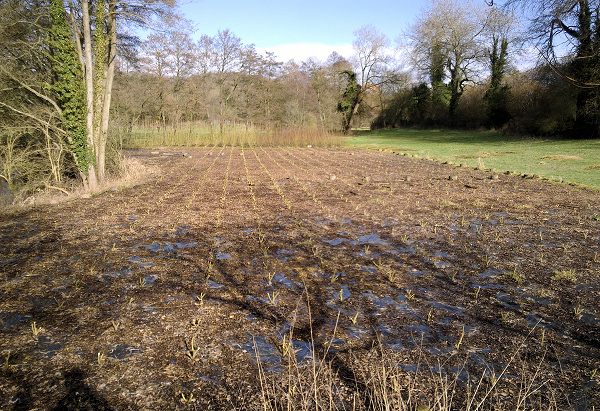
This weekend we’ve been helping out at Radford Mill Farm with their willow harvest. Willow cuttings had been planted approximately a year ago and had already grown 8-14 feet in height depending on species. There were several thousand trees of around 10 different species, most planted at 1m spacing, some a little tighter. A black plastic mulch had been used, now covered in last years leaves.

Willow

1 year old, before cutting.

It was quite a job and took a dozen people the whole day to cut the field. A range of saws and secateurs were used with people taking turns at cutting, collecting, sorting and bundling.

Willow

Many hands make light work

The trees are cut right back, with only a few buds of last years growth left above ground. It is from these buds that this years growth, at least as vigorous as last years, will come.

Willow

All that remains after harvesting

By mid afternoon two thirds of the field was cleared. They did a good job last year with the uniform planting!

Willow

Two thirds of the field cleared

The different species and lengths needed to be sorted and bundled. This willow will be used for basket work, sculpture, living fencing and protecting the banks of a stream that runs through the farm.

Willow

Willow is sorted and bundled

To expand the willow plantation all that is needed are cuttings. Approximately a foot long, these cuttings are simply pushed into the ground (the right way up!) leaving a few buds above surface. This is how the willow we were cutting this weekend started a year ago. The simplicity and rate of growth is really amazing.

Willow

~1 foot cuttings

Willow

New cuttings, ~1m spacing

Finally, with the harvest complete we started on the fence. Long rods of over 10 foot are just pushed six inches into the ground, 3 inches apart and at 45 degrees to each other. They are woven between one another with the tops twisted together. The idea is that each rod will root and new growth can be woven back into the fence. We’ll definitely be back towards the end of the summer to see how it’s grown!
Willow

Living willow fence

Willow

Living willow fence

It was a really fun weekend, hard work but great to be outside and working towards something so tangible. I’m really impressed at how simple and productive willow growing can be and how versatile the product.

Allotment Update No. 11

Follow the allotment series here.

No more photos of muddy fields today! Last weekend we went to the Somerset Potato Day, in Pylle. It was an amazing event, around a hundred different varieties of potato, sold by the tuber. Rather like a muddy pick ‘n’ mix! It was also extremely busy. The choice was somewhat bewildering so we decided to limit ourselves to ten tubers of just five different varieties, making sure we got a spread from 1st early to late maincrop. Here’s what we ended up with:

Foremost 1st Early
Waxy flesh. When first added to the national list in 1954 it was Suttons Foremost and an instant hit with gardeners who liked its excellent flavour and resistance to disintegration when boiling. Good common scab resistance. Short to oval in shape with white skin and waxy white flesh.
Use: Salad, Bake, Boil, Roast.

Roseval 2nd Early
Salad, smooth, deep red skinned with yellow flesh salad variety, sometimes with a pink flush. The flesh is waxy with a truly suburb flavour. Excellent for salad use, hot or cold. A very pretty variety, good cooking quality. Popular in France, rare in UK.

Sarpo Shona Early Maincrop
Short growing, weed smothering, slightly oval shaped early maincrop with white skin, creamy flesh and shallow eyes, plus a great resistance to blight.

Pink Fir Apple Late Maincrop
Waxy flesh, good flavour. Just brush off under the tap and steam in its skin, don’t worry if bits break off them, cook them all. It does tend to wander so make sure to dig up all the tubers.
Recommend use: Boil, Salad.

Kerrs Pink Late Maincrop
Floury flesh. Raised in Scotland by James Henry, very vigorous foliage, the age shows in the deep eyes and good flavour. Recommend use: Chip, Mash, Roast.

Seed Potatoes

Seed Potatoes, 18th Feb 2011

Before planning potatoes must be chitted. This is just allowing them to sprout before planting and what we started today. It’s recommended to allow around six weeks for chitting. Each potato has one end a little more rounded or blunt with a few ‘eyes’. We stand them, this blunt end uppermost, in egg boxes or similar, in a cool and light place. Our loft with its skylights seems ideal. Once the shoots are 0.5-1 inches long they are ready to plant. This should be around the last week of March.

1st earlies should be ready after around 10 weeks and the maincrop more like 20. Fingers crossed for mid June!

Seed Potatoes

Seed Potatoes, 18th Feb 2011

Seed Potato Catalogue

Seed Potato Catalogue

Allotment Update No. 10

Follow the allotment series here.

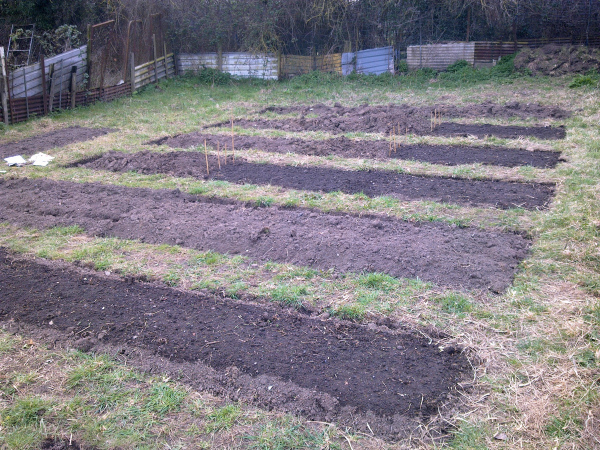
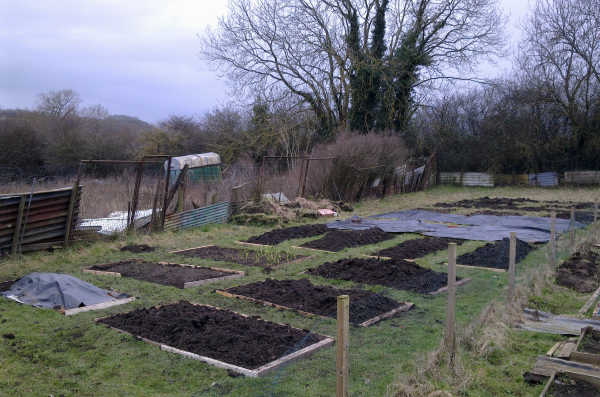
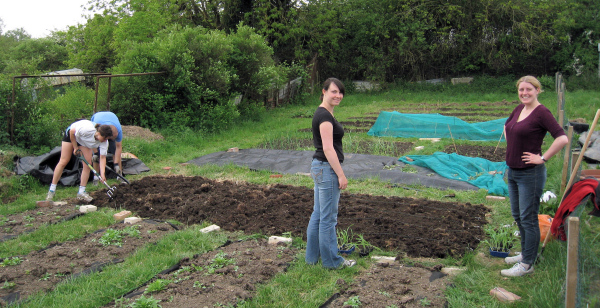
More digging on the allotment. Gradually, it’s looking more like an allotment and less like the field we took on last year. The first image is from the front, looking back in a westerly direction. The green grass in the foreground is the stuff we cut throughout the summer.

Allotment

Looking west, 5th Feb 2011.

The plastic sections in the middle are experimental. We’re wondering what impact four months under cover will have on the grass. The grass left uncut towards the back, is brown.

In total, from front to back we have the following beds:

  • Six 2.5 x 1.25 m (one full of onions, one half garlic and half onions)
  • Four 1 x 4 m
  • Two 5.5 x 2 m
  • Three 1.5 x 2 m (one full of onions, one half garlic)
  • One 5.5 x 1 m
  • Two 2.5 x 1.25 m
  • One 5.5 x 1 m

From the other end, these are the more recent beds.

Allotment

Looking east, 5th Feb 2011.

There’s still quite a bit of room, around 10 m undug. We should manage to finish all the beds over the next month or so. We’re adding manure as we go along, hardly making a dent in the heap!

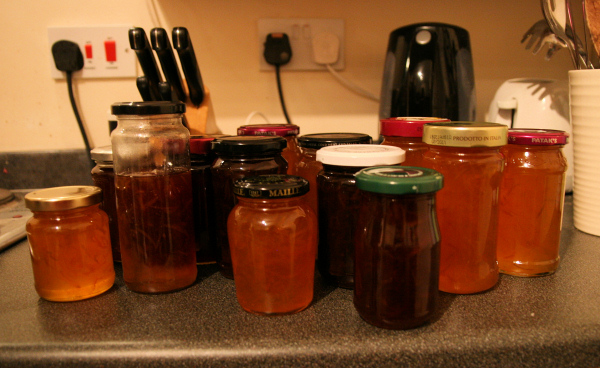
Marmalade

Seville oranges are in season in January and February as they require cool temperatures to promote the release of the orange pigments. Oranges in the summer come to the UK from the southern hemisphere. Luckily for us the Spanish are not fans of marmalade and as Seville oranges are too bitter to eat most are exported to the UK. Here’s the marmalade recipe we made at the weekend.

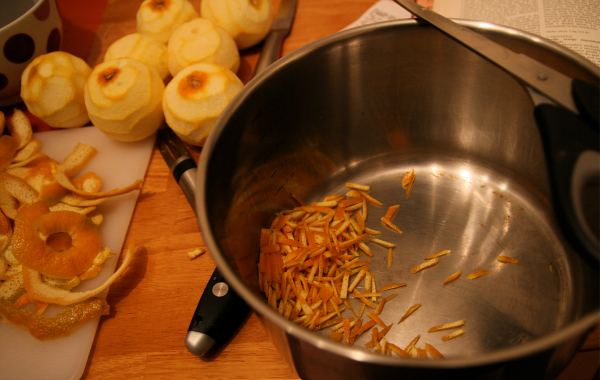
Marmalade

Peeling the oranges

1.5 kg of Seville oranges, £1.96
3 kg sugar, £2.01
2 lemons, £0.48
3 litres water

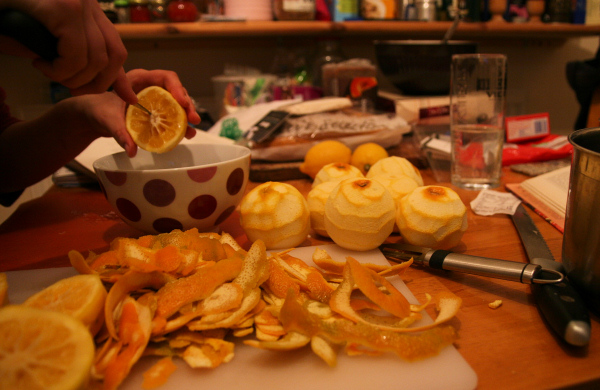
Peel the oranges so they look like the photo below. It’s good to try and get the peel off in long strips, it makes the snipping easier! With scissors snip the peel into the bits you want to see in the marmalade. Halve the oranges and squeeze out all the juice, flesh and pips. Add the juice and flesh to the pan with the peel. Keep the pips separate. Finally pull out all the membranes and add to the pips in a second pan. The pips and membranes can also be tied in a muslin bag and left in the main pan.

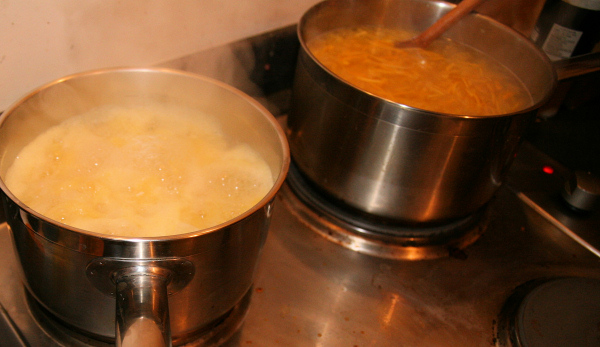
Split the water between the two pans, with most going with the peel in a large pan. The pips and membranes in a small pan don’t need so much. Simmer both pans for about 2 hours until the peel has softened and about half the water has evaporated. Don’t skimp on this stage it takes time to soften the peel. Drain the pip and membrane mixture (with all its pectin) through a sieve into the main pan. At this point we split the mixture equally between to pans, adding a table spoon of treacle to one for a darker colour. Finally add the sugar and boil rapidly for around 15 minutes. Test for set on a cold plate, when it wrinkles we’re done. It’s important to leave the mixture to cool for another 15 minutes or so before potting or the peel will rise to the surface.

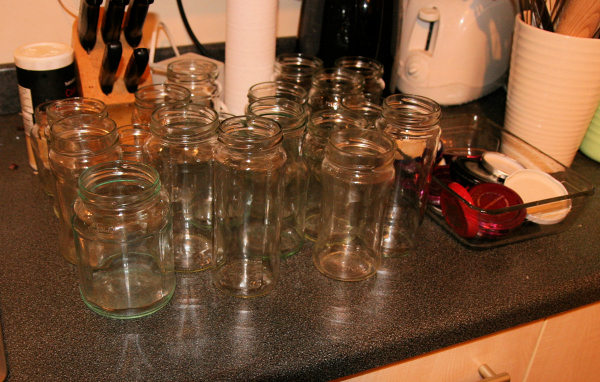
We prepare the jars by washing thoroughly in hot soapy water, rinsing then placing in the oven at around 120C for 20 minutes.

Marmalade

Juicing

Marmalade

Simmer for a couple of hours to soften peel

Marmalade

Add treacle for a darker colour

Marmalade

Final 15-30 minutes with the sugar

Marmalade

Clean jars

Marmalade

The end result!

We finished up with about 4 kg of marmalade in 12.5 jars. The total cost of ingredients was £4.45, so around 36 pence a jar! 😀

Allotment Update No. 9

Follow the allotment series here.

Returning to the allotment in January after the seriously cold December we discovered evidence of trespass. Rabbits, we presume, had been at the garlic and remaining carrot tops. The carrots had been chewed to the ground, however, the garlic had only been nibbled. Each plant had lost its top couple of inches. Maybe the garlic isn’t really to the rabbit’s taste and gets stronger further down the plant?

Garlic

Nibbled garlic, 8th January 2011.

Carrots

Nibbled carrots, 8th January 2011.

Note the Leporidae evidence in the bottom left. We decided to harvest all the remaining carrots, before the rabbits decided to dig them up! We ended up with ~2.5 kg once topped and washed. The whole bed probably produced around 6 kg in total. What is one to do with 2.5 kg of fresh carrots?

Carrots

Preparing 2.5 kg of carrots.

Carrots and coriander soup of course!

Carrot and coriander soup

Carrot and coriander soup.