The allotment had previously been a grassy meadow, so we thought the soil could do with some improvement. A local organic farmer was offering trailer loads of well rotted cow manure for the bargain price of £20. After one failed attempt (due to a locked gate-top) we took delivery:
Manure arrives, 14th Nov 2010
Unfortunately, the tractor couldn’t get all the way in to our allotment, so the whole four and a half tonne pile needed to be moved approximately 20m:
It all needs moving, 17th Nov 2010
It took a long time and a lot of wheelbarrow loads:
Half done, 21st Nov 2010
After 88 wheelbarrow journeys it was done!
All done! 21st Nov 2010
We put some of it onto the beds already dug (~1 barrow load per square metre), and heaped up the rest in the corner:
Distributed between the beds and a heap in the corner, 21st Nov 2010
Our first proper harvest from the allotment today. We planted the carrots on 1st August, 13 weeks to the day here’s some of what we have:
Carrots 31st October 2010
The garlic was planted on the 10th October, here it is three weeks on:
Garlic, three weeks old. 31st October 2010
The red onions we planted three weeks ago are just breaking the surface, not as impressive as the garlic yet. Erica meticulously prepared this bed for a second batch of onions which went in today. There were lots of worms!
Preparing the onion bed, 31st October 2010
I dug another two 3m x 1m beds. The turf going into the compost. Here’s the compost heap with its turf walls:
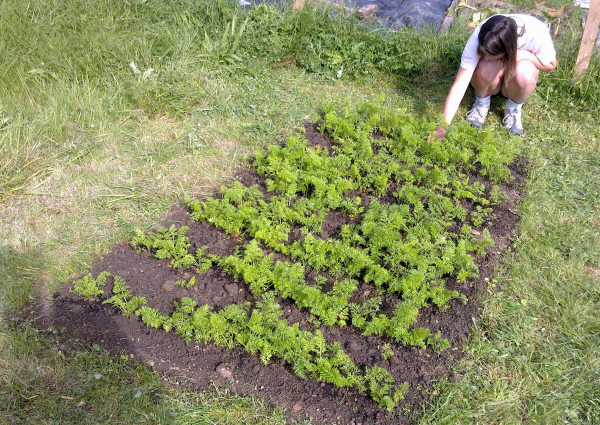
Eight weeks now since the carrots were planted, we’ve weeded and thinned them today. Some of the thinnings were certainly substantial enough to eat in a salad.
26th September 2010
26th September 2010
And here’s the allotment as it’s looking today. There are six beds, each 2.5 x 1.25 m (~8’ by 4’) with a half metre paths between. So far only the carrots has been planted.
The other five beds are a bit of an experiment. We started of with a meadow full of thistles (see first Allotment Update) and need to work out the best way to create the beds. One has some skipped black plastic, two have a mulch of grass/thistle/nettle cuttings and two are left bare. Each visit we weed the bare beds, and pluck out anything that’s found a way through the mulch. We’re also cutting the grass paths short.
1008 Intel Nehalem compute nodes with two 4-core processors;
8064 processor-cores providing over 72 TFlops;
Standard compute nodes have 22 GB of RAM per node;
32 high-memory nodes with 45 GB of RAM per node;
All nodes are connected to a high speed disk system with 110 TB of storage;
In the video Dr Oz Parchment suggests that in the world supercomputer ranking this new system would place around 83rd, interestingly he also notes that 5-6 years ago it could have been number 1. That’s the pace of computer improvement. Let’s compare with the basic office PC I’m writing this on, it cost around £600. It’s based around Intel’s Core i5-750 CPU, running at 2.66GHz. The Intel specification sheet give this CPU a floating point performance of 42.56 GFlops (billion floating point operations per second). This sounds reasonable when we consider the supercomputer with its 2016 CPUs is reported to have 72 TFlops suggesting 36 GFlops per processor. After all, Supercomputers are just large numbers of regular processors (and memory) connected together with a fast bus.
We can run Parchment’s rough calculation for my computer. How far back in time do we have to go for my standard desktop PC to be considered a supercomputer?
Since 1993 a list of the world’s fastest supercomputers has been maintained, Top 500. Going back to the beginning, we see that in 1993 a CM-5/1024 developed by Thinking Machines Corporation and owned by Los Alamos National Laboratory in the US held the top spot. This was also the computer used in the control room in the Jurassic Park film. Here’s what just a few nodes looked like, the Los Alamos system was far larger:
Thinking Machines' CM-5 Supercomputer
Being the fastest computer of it’s day it would have cost millions, been staffed by a team of engineers and scientists and been employed on the most computationally taxing investigations being carried out anywhere in the world. I expect it spent most of its time working on nuclear weapons. According to this the CM-5 cost $46k per node in 1993, which would price the Los Alamos National Laboratory system at $47 million, or around $70 million in today’s money. It’s performance? A theoretical peak of 131 GFlops, with a benchmark achieved performance of 59.7 GFlops. The same ball park as my run of the mill office computer today. It was also twice as fast as number two and ten times the power of the 20th ranked system.
What this means is that the computational resources available at the cutting edge just 17 years ago, now sit on everyone’s desk running Office 2010.
In 1997 I was lucky enough to visit the European Centre for Medium-Range Weather Forecasts (EMCWF). They had recently taken delivery of a new Fujitsu VPP700/116 and had claimed the 8th spot in the Top 500 ranking with a theoretical peak of 255.2 GFlops. The system was used for 10-day weather forecasts. This image shows a 56 node VPP700 system, the EMCWF system was ~twice the size:
Fujitsu VPP700 Supercomputer
Using off the shelf components, a similarly powerful desktop computer could be built for a few thousand pounds using four Intel Xeon processors.
State of the art computer performance from a little over a decade ago, is now available to everyone able to afford a modern PC. We’re all using supercomputers. Could we be doing more with our computers than playing games and Microsoft Office 2010?
Back in December, after the Copenhagen climate conference I wrote a quick post about China’s awkwardness. I suggested a ‘coalition of the willing’ comprising of those governments that were willing to make emission reductions should just get on with it, without the rogue states.
Today I’ve come across Coalition of the Willing, a fantastic little film about addressing climate change without the illusive unanimous agreement between governments.
‘Coalition of the Willing’ is a collaborative animated film and web-based event about an online war against global warming in a ‘post Copenhagen’ world.
‘Coalition of the Willing’ has been Directed and produced by Knife Party, written by Tim Rayner and crafted by a network of 24 artists from around the world using varied and eclectic film making techniques. Collaborators include some of the world’s top moving image talent, such as Decoy, World Leaders and Parasol Island.
The film offers a response to the major problem of our time: how to galvanize and enlist the global publics in the fight against global warming. This optimistic and principled film explores how we could use new Internet technologies to leverage the powers of activists, experts, and ordinary citizens in collaborative ventures to combat climate change. Through analyses of swarm activity and social revolution, ‘Coalition of the Willing’ makes a compelling case for the new online activism and explains how to hand the fight against global warming to the people.
To find out all about the project and to join our Facebook page, follow us on Twitter, or get the iPhone App visit: http://coalitionofthewilling.org.uk/
Erica’s brother came to visit this weekend. That’s him in the photo, having hacked down a lot of the remaining meadow, thanks Mark!
1st Aug 2010
We’ve finally planted something too. In these rows are planted carrot seeds we recently bought from The Real Seed Catalogue. They have a really nice philosophy, well worth checking out.
At the weekend we marked out two beds with old guy ropes, tent pegs and a little help from Pythagoras. The plot is approximately 8 m wide, so we’ve gone for two 2.5 x 1.25 m (~8’ by 4’) with a half metre path between and around 1 m wide paths at either end.
All we did was dig the turf ~4” deep and flip it back over, green side down. Fairly hard work after a 10 mile run a couple of hours earlier! So it looks like this:
First bed.
Somewhat concerned about the grass just growing skyward again, we put the previously chopped down long grass, thistles and nettles on top before leaving. Will the grass just grow back through?