Category Archives: Food

Allotment Update No. 13

Follow the allotment series here.

It’s been a while since the last update, with the improving weather a lot’s been going on at the allotment. On the 18th February we started chitting the potatoes. Four weeks later, there had been some progress:
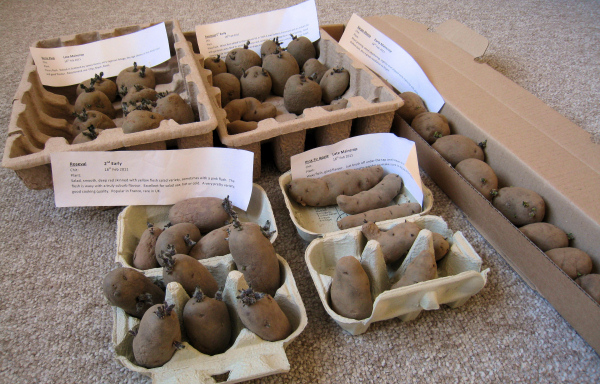
Chitted potatoes

Four weeks chitting, 18th Feb to 20th March

The ‘before’ image is here: 18th Feb.

Of our five variates, Foremost (1st Early), Roseval (2nd Early), Sarpo Shona (Early Maincrop) and Kerrs Pink (Late Maincrop) have chitted nicely, ready to plant. Pink Fir Apple (Late Maincrop), however, hasn’t done much. There are some shoots but not ready for planting yet. We’ll give it another couple of weeks.

Chitted potatoes

Chitted potatoes, 20th March 2011

Here they are going in; the earlies are spaced 30 cm apart in rows around 40 cm apart and the rest spaced 40 cm apart.

Potatoes

Potatoes going in, 20th March 2011

Potatoes

Potatoes going in, 20th March 2011

We’ve also been improving the rabbit proofing, adding chicken wire to the gate, fixing a bit of fence, blocking up holes… it’s not obvious where they can get in now.

This weekend (26th March) we’ve been busy planting, and weeding. The thistles have the potential to be a problem. The meadow before we started digging was full of thistles and their remaining roots are spawning babies everywhere!

We added some more parsnips and cabbage, a few weeks after the first sowing. Sown the first time this year are: carrots, turnips, beetroot, bunching onions and leeks. We also dug a new bed along the fence and sowed a mixed pack of wild flower seeds.
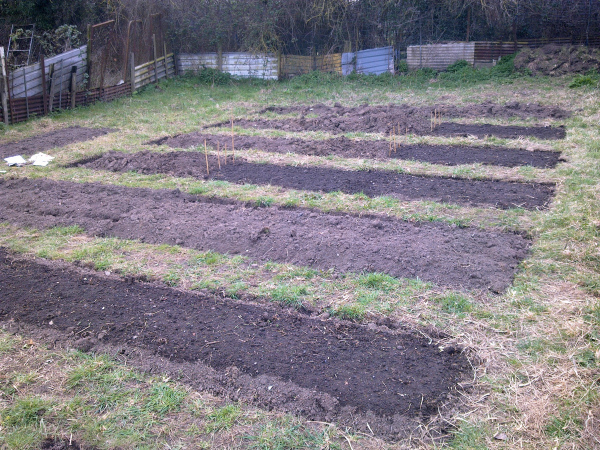
Seed beds

Seed beds


From top to bottom in the photo: carrots, beetroot, parsnips, potatoes and cabbage with more potatoes in the top left.

Allotment Update No. 11

Follow the allotment series here.

No more photos of muddy fields today! Last weekend we went to the Somerset Potato Day, in Pylle. It was an amazing event, around a hundred different varieties of potato, sold by the tuber. Rather like a muddy pick ‘n’ mix! It was also extremely busy. The choice was somewhat bewildering so we decided to limit ourselves to ten tubers of just five different varieties, making sure we got a spread from 1st early to late maincrop. Here’s what we ended up with:

Foremost 1st Early
Waxy flesh. When first added to the national list in 1954 it was Suttons Foremost and an instant hit with gardeners who liked its excellent flavour and resistance to disintegration when boiling. Good common scab resistance. Short to oval in shape with white skin and waxy white flesh.
Use: Salad, Bake, Boil, Roast.

Roseval 2nd Early
Salad, smooth, deep red skinned with yellow flesh salad variety, sometimes with a pink flush. The flesh is waxy with a truly suburb flavour. Excellent for salad use, hot or cold. A very pretty variety, good cooking quality. Popular in France, rare in UK.

Sarpo Shona Early Maincrop
Short growing, weed smothering, slightly oval shaped early maincrop with white skin, creamy flesh and shallow eyes, plus a great resistance to blight.

Pink Fir Apple Late Maincrop
Waxy flesh, good flavour. Just brush off under the tap and steam in its skin, don’t worry if bits break off them, cook them all. It does tend to wander so make sure to dig up all the tubers.
Recommend use: Boil, Salad.

Kerrs Pink Late Maincrop
Floury flesh. Raised in Scotland by James Henry, very vigorous foliage, the age shows in the deep eyes and good flavour. Recommend use: Chip, Mash, Roast.

Seed Potatoes

Seed Potatoes, 18th Feb 2011

Before planning potatoes must be chitted. This is just allowing them to sprout before planting and what we started today. It’s recommended to allow around six weeks for chitting. Each potato has one end a little more rounded or blunt with a few ‘eyes’. We stand them, this blunt end uppermost, in egg boxes or similar, in a cool and light place. Our loft with its skylights seems ideal. Once the shoots are 0.5-1 inches long they are ready to plant. This should be around the last week of March.

1st earlies should be ready after around 10 weeks and the maincrop more like 20. Fingers crossed for mid June!

Seed Potatoes

Seed Potatoes, 18th Feb 2011

Seed Potato Catalogue

Seed Potato Catalogue

Marmalade

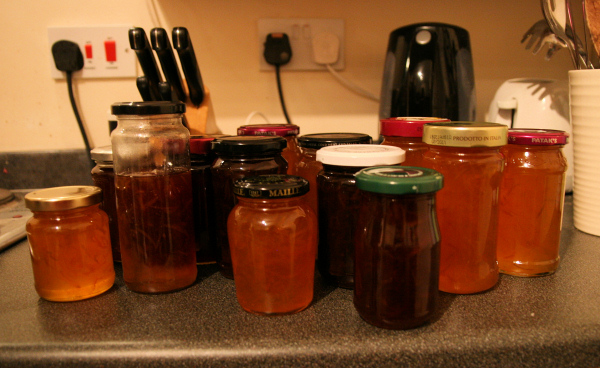
Seville oranges are in season in January and February as they require cool temperatures to promote the release of the orange pigments. Oranges in the summer come to the UK from the southern hemisphere. Luckily for us the Spanish are not fans of marmalade and as Seville oranges are too bitter to eat most are exported to the UK. Here’s the marmalade recipe we made at the weekend.

Marmalade

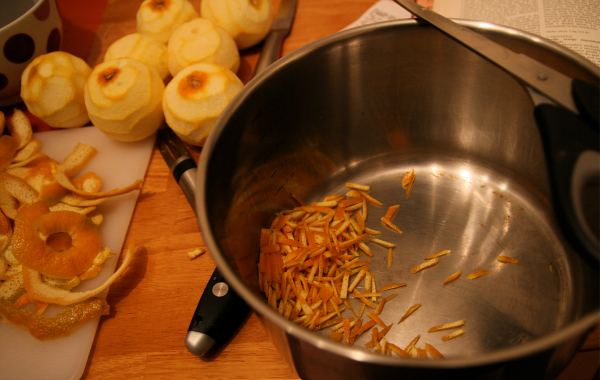
Peeling the oranges

1.5 kg of Seville oranges, £1.96
3 kg sugar, £2.01
2 lemons, £0.48
3 litres water

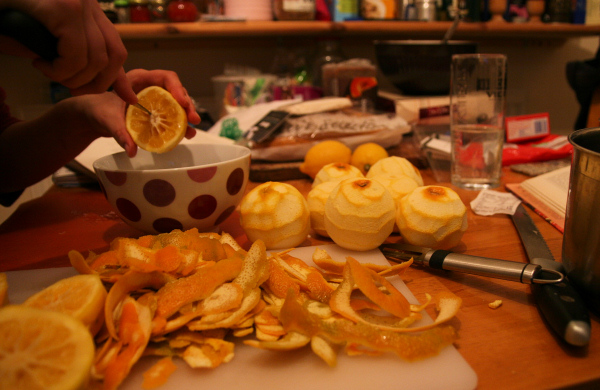
Peel the oranges so they look like the photo below. It’s good to try and get the peel off in long strips, it makes the snipping easier! With scissors snip the peel into the bits you want to see in the marmalade. Halve the oranges and squeeze out all the juice, flesh and pips. Add the juice and flesh to the pan with the peel. Keep the pips separate. Finally pull out all the membranes and add to the pips in a second pan. The pips and membranes can also be tied in a muslin bag and left in the main pan.

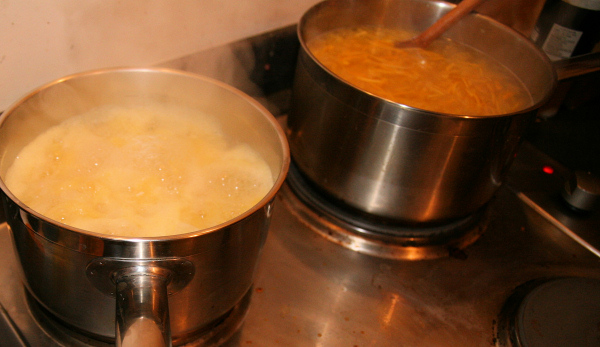
Split the water between the two pans, with most going with the peel in a large pan. The pips and membranes in a small pan don’t need so much. Simmer both pans for about 2 hours until the peel has softened and about half the water has evaporated. Don’t skimp on this stage it takes time to soften the peel. Drain the pip and membrane mixture (with all its pectin) through a sieve into the main pan. At this point we split the mixture equally between to pans, adding a table spoon of treacle to one for a darker colour. Finally add the sugar and boil rapidly for around 15 minutes. Test for set on a cold plate, when it wrinkles we’re done. It’s important to leave the mixture to cool for another 15 minutes or so before potting or the peel will rise to the surface.

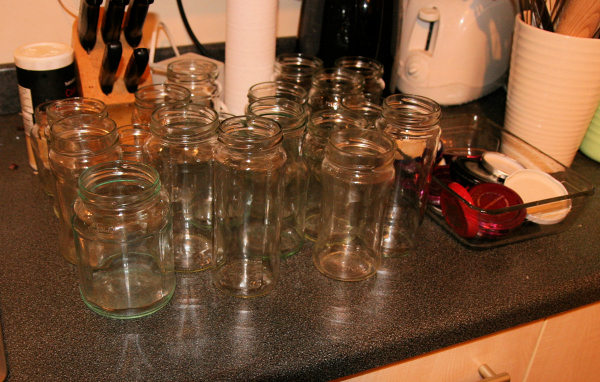
We prepare the jars by washing thoroughly in hot soapy water, rinsing then placing in the oven at around 120C for 20 minutes.

Marmalade

Juicing

Marmalade

Simmer for a couple of hours to soften peel

Marmalade

Add treacle for a darker colour

Marmalade

Final 15-30 minutes with the sugar

Marmalade

Clean jars

Marmalade

The end result!

We finished up with about 4 kg of marmalade in 12.5 jars. The total cost of ingredients was £4.45, so around 36 pence a jar! 😀

Allotment Update No. 9

Follow the allotment series here.

Returning to the allotment in January after the seriously cold December we discovered evidence of trespass. Rabbits, we presume, had been at the garlic and remaining carrot tops. The carrots had been chewed to the ground, however, the garlic had only been nibbled. Each plant had lost its top couple of inches. Maybe the garlic isn’t really to the rabbit’s taste and gets stronger further down the plant?

Garlic

Nibbled garlic, 8th January 2011.

Carrots

Nibbled carrots, 8th January 2011.

Note the Leporidae evidence in the bottom left. We decided to harvest all the remaining carrots, before the rabbits decided to dig them up! We ended up with ~2.5 kg once topped and washed. The whole bed probably produced around 6 kg in total. What is one to do with 2.5 kg of fresh carrots?

Carrots

Preparing 2.5 kg of carrots.

Carrots and coriander soup of course!

Carrot and coriander soup

Carrot and coriander soup.

Allotment Update No. 7

Follow the allotment series here.

Our first proper harvest from the allotment today. We planted the carrots on 1st August, 13 weeks to the day here’s some of what we have:

Carrots

Carrots 31st October 2010

The garlic was planted on the 10th October, here it is three weeks on:

Garlic

Garlic, three weeks old. 31st October 2010

The red onions we planted three weeks ago are just breaking the surface, not as impressive as the garlic yet. Erica meticulously prepared this bed for a second batch of onions which went in today. There were lots of worms!

Onion bed

Preparing the onion bed, 31st October 2010

I dug another two 3m x 1m beds. The turf going into the compost. Here’s the compost heap with its turf walls:

Compost heap

Compost heap, 31st October 2010

Leek and Goats’ Cheese Quiche

Quiche

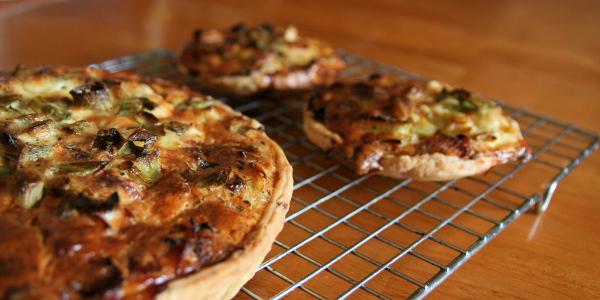
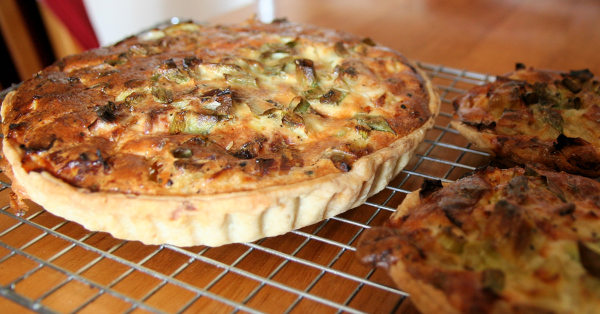
Leek and Goats' Cheese Quiche.

The Pastry

  • 110 g plain flour
  • 50 g butter
  • 25 g goats’ cheese
  • pinch of salt

The Filling

  • 350 g leeks
  • 175 g goats’ cheese
  • 3 eggs
  • 200 ml crème fraîche (or double cream)
  • 4 spring onions
  • Salt and pepper

1. Make the pastry: sift the flour and salt into a bowl, mix in the butter with fingertips, grate in the goats’ cheese, sprinkle on a tbs or so of cold water and bring the dough together with a knife. Put it in a plastic bag and put it in the fridge for half an hour.

2. Heat oven to 190ºC, fan-assisted 170ºC. Grease a 20cm quiche tin maybe add baking parchment.

3. Chop the leeks and gently fry in butter for 10-15 minutes, add a bit of salt.

4. Whisk the eggs in a jug.

5. Roll out the pastry and line the tin. I had a little left over so I made two small tarts as well.

6. Prick the pastry to let any air out when cooking, brush with a little egg and pop into the oven for 20-25 minutes.

7. With the leeks off the heat in a bowl, having drained any excess liquid, crumble in the goats’ cheese.

8. Add the crème fraîche to the eggs, add lots of freshly ground black pepper.

9. Add the leek and cheese mixture to the pastry, sprinkle chopped spring onion on top.

10. Gently and slowly pour the egg mixture over the leeks.

11. Back into the oven for 30-35 minutes until golden brown on top.

12. Let it rest for 10 minutes before serving.

Quiche

Leek and Goats' Cheese Quiche.

Allotment Update No. 1

Erica and I received the key to our new allotment this week. It’s new not only to us but also to allotmenting in general by the looks of it, with no evidence of previous cultivation. It’s around 8m by 30m and currently just grass with a smattering of thistles and nettles. It runs east-west on a slightly south sloping site.

Allotment

Initial condition - 16th July 2010.

First job has been to hack back the foliage so we can get to the ground to dig the beds. Size and shape of beds is currently under discussion – any ideas?
Allotment

8 meter square cleared, ready to be dug.

The one crop we should get this year is blackberries!
Allotment

This year's blackberries.

Parsnip and Maple Syrup Cake

Parsnips are great, why not in a cake? This was my birthday cake in 2010.

The Cake

  • 175g butter
  • 250 g demerara sugar
  • 100 ml maple syrup
  • 3 large eggs
  • 250 g self-raising flour
  • 2 tsp baking powder
  • 2 tsp mixed spice
  • 250 g parsnips , peeled and grated
  • 1 medium eating apple , peeled, cored and grated
  • 50 g pecans , roughly chopped
  • zest and juice 1 small orange

The topping (or filling)

  • 250 g tub mascarpone
  • 3-4 tbsp maple syrup

1. Heat oven to 180ºC, fan-assisted 160ºC. Grease 2 x 20cm sandwich tins and line the bases with baking parchment. Or just use a loaf tin like I did.

2. Melt butter, sugar and maple syrup in a pan over gentle heat, then cool slightly.

3. Whisk the eggs into this mixture, then stir in the flour, baking powder and mixed spice, followed by the grated parsnip, apple, chopped pecans, orange zest and juice.

4. Pour into the tin(s), and bake for 25-30 mins until the tops spring back when pressed lightly.

5. Cool slightly in the tins before turning out onto wire rack to cool completely.

6. Just before serving, and absolutely when fully cooled, mix together the mascarpone and maple syrup. Spread over one cake and sandwich with the other or just spread on top if only one tin was used and you don’t fancy cutting it in half! If the mascarpone went in the middle, dust with icing sugar before serving.

Parsnip Birthday Cake

Banana, Chocolate and Oat Muffins

I love cooking with oats, banana and chocolate. These muffins are low in fat too, just great!

Ingredients makes ~16 muffins

  • 25 ml vegetable oil
  • 2 bananas, coarsely mashed
  • 1 large egg
  • 250 ml milk
  • 300 g self-raising white flour
  • 100 g rolled oats (plus for more for topping)
  • 150 g caster sugar or soft light brown sugar
  • ½ teaspoon bicarbonate of soda
  • 1 teaspoon cinnamon
  • 50 g dark chocolate finely chopped

1. Heat the oven to 180ºC (fan assisted), I guess a little hotter if not.

2. Beat the egg and mix all the wet ingredients together.

3. Sift the flour, sugar, cinnamon and bicarbonate of soda into a large mixing bowl. Add the oats.

4. Fold in the wet ingredients, mashed banana and chocolate chips. Minimal mixing to preserve air.

5. Spoon the mixture into muffin cases, filling them about two-thirds full. Sprinkle some oats on the top.

6. Bake for 25-30 minutes, or until the muffins have risen and are lightly browned.

In my experience muffin recipes are fairly forgiving. I’ve pretty much made this one up. The banana and chocolate could certainly be replaced with other interesting fruit or some wholemeal flour could be used.

Banana, chocolate and oat muffins

Beetroot Chocolate Cake

Here’s a quite awesome chocolate cake. No butter, lots of fresh (not pickled!!) beetroot gives it a lovely moist texture. It’s healthy too, for a chocolate cake!

The cake

  • 250 g dark chocolate
  • 3 medium eggs
  • 250 g light muscovado sugar
  • 1 teaspoon vanilla essence
  • 2 tablespoons maple syrup
  • 2 tablespoons clear honey
  • 40 g self-raising flour
  • 40 g plain flour
  • 1/4 teaspoon bicarbonate of soda
  • 1/4 teaspoon salt
  • 25 g cocoa powder
  • 50 g ground almonds
  • 250 g raw beetroot, peeled and finely grated
  • 100 ml strong black coffee, optional
  • 30 ml sunflower oil

The topping

  • 150 g dark chocolate
  • 1 teaspoon vanilla essence
  • 3 tablespoons clear honey

1. Heat a conventional oven to 160ºC, or a fan-assisted one to 140ºC. Grease a round 20cm diameter by 8cm high loose-bottomed tin.

2. Melt the chocolate in a bowl over a pan of simmering water until all dissolved, set aside to cool.

3. Beat the eggs with the sugar, vanilla essence, the maple syrup and the honey vigorously for three minutes until pale and quite fluffy.

4. Fold in the flours, bicarbonate of soda, salt, cocoa and ground almonds.

5. Using some kitchen paper, dab the grated beetroot thoroughly to remove some of the excess moisture. Fold in the beetroot, cooled chocolate, (option) coffee and oil until thoroughly mixed together.

6. Pour the mixture into the tin and cook in the middle of the oven for 1 hour 30 minutes. After this time, cover the cake with foil and bake for another 30 minutes.

7. Test the cake by inserting a skewer into the centre to see if it comes out clean (although this cake is so moist that even when the cake is fully cooked, the skewer comes out looking slightly messy). Leave to cool on a wire rack.

8. To make the topping, melt the chocolate gently in a bowl over a pan of simmering water, then remove from the heat and add the vanilla essence and honey.

9. Set aside to cool for at least 15 minutes before icing the cake. Cut the cake through the middle and ice it in the centre (jam?) and on all sides.

And here’s what it should look like!

Beetroot chocolate fudge cake

This recipe is based on: Beetroot chocolate fudge cake